What Beats a Straight in Poker?
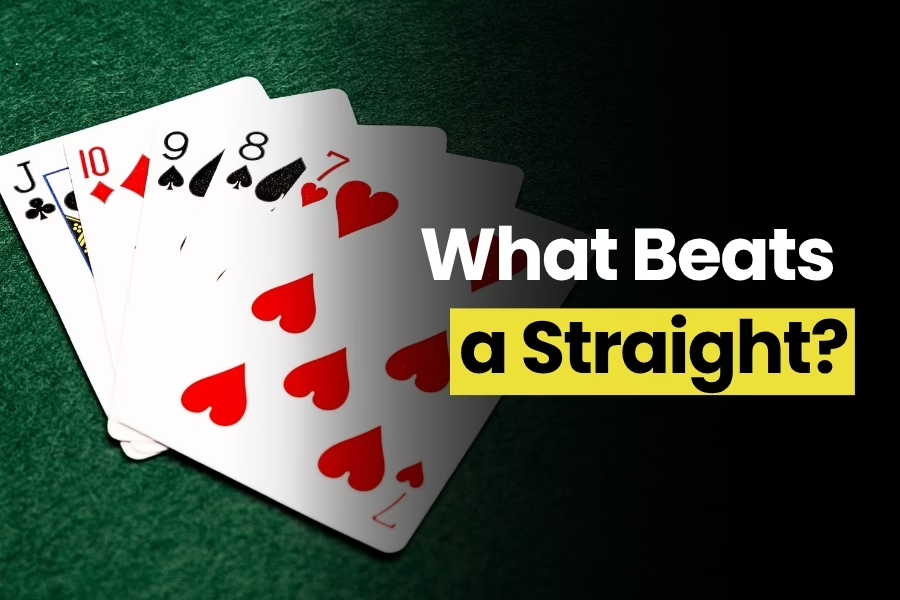
Five hands beat it. Everything else loses. The ranking is simple. The arguments at the table usually are not.
A straight is five cards in a row. The suits do not have to match. It is a strong hand, and it is not the top of the chart.
- Beats a straight: Flush, full house, four of a kind, straight flush, royal flush.
- Loses to a straight: Three of a kind, two pair, one pair, high card.
If two players both have a straight, the one with the higher top card wins. If the five cards are the same, the pot is split. The ace can sit at the top of a straight or at the bottom. It cannot do both at once. Those are the rules in a normal deck. Most of the confusion at a home game comes from ignoring one of them.
The short answer
A flush, a full house, four of a kind, a straight flush, and a royal flush all beat a straight. A straight beats three of a kind, two pair, one pair, and high card. Between two straights, the higher top card wins, and identical straights split.
Poker Hand Rankings: What Beats a Straight?
| Hand | Against a straight | Plain example |
|---|---|---|
| Royal flush | Wins | A-K-Q-J-10, one suit |
| Straight flush | Wins | 9-8-7-6-5, one suit |
| Four of a kind | Wins | Four sevens, any fifth card |
| Full house | Wins | Kings full of sixes |
| Flush | Wins | Any five hearts, not in sequence |
| Straight | Tie, or higher top card | Higher top card wins |
| Three of a kind | Loses | Three aces |
| Two pair | Loses | Aces and kings |
| One pair | Loses | A pair of aces |
| High card | Loses | Ace high |
Want a full breakdown of every poker hand? Check out our guide to what are the poker hand rankings.
The five hands that beat a straight
Poker scores the best five-card hand. It does not score how the hand felt, how rare the hole cards were, or who had been ahead on the flop. Name the five cards. Then place that hand on the chart.
1. Flush
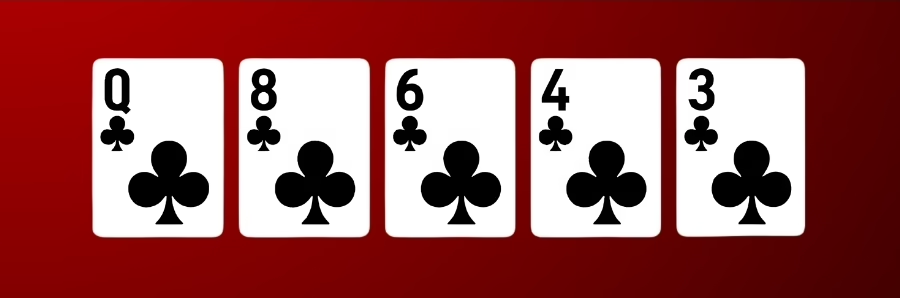
Five cards of one suit, not in sequence.
The lowest flush in the deck beats the highest straight in the deck. A player with 2-3-4-5-7 of hearts beats a player holding ace-king-queen-jack-ten in mixed suits. Players argue this one more than any other ranking, usually because the straight looks orderly and the flush looks like a pile of rags. Order on the rank line does not matter. The suit line does.
A flush is rarer than a straight in a 52-card deck, which is why it sits above it. In five-card combinations there are 10,200 straights and 5,108 flushes, once straight flushes are taken out of both counts and given their own row. Rarer hands rank higher. That is the whole logic of the chart.
How it works in Hold’em
In Hold’em a flush needs three cards of one suit on the board, because a player has only two hole cards. A two-tone flop can still make a flush by the river. A rainbow river, with no three cards of one suit, cannot. On that board a straight does not have to worry about a flush. On a three-heart board it does.
2. Full House
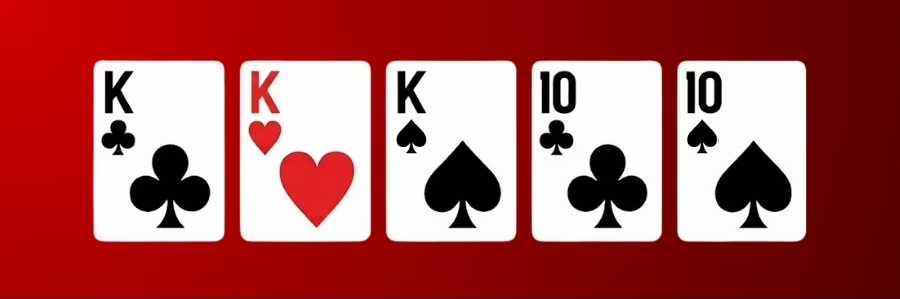
Three of a kind plus a pair.
Kings full of sixes beat any straight. Deuces full of aces beat any straight. The pair does not have to be big. The trips do not have to be big. Aces and kings in the hole do not make a full house by themselves. You need the trips and the pair inside the same five-card hand.
Example: A paired board
On a board of 9-9-8-7-6, a player with jack-ten has a straight and is losing to anyone who can make nines full. A player with pocket eights has eights full of nines. A player with a nine and a six has nines full of sixes.
The straight that was the nuts on the flop of 9-8-7 is no longer the nuts once the board pairs.
3. Four of a Kind
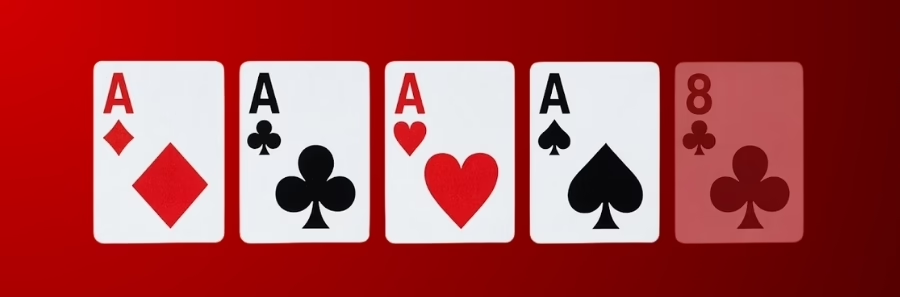
All four cards of one rank, plus a fifth card that does not change the name of the hand.
Quad sevens beat a king-high straight. Quad twos beat broadway. In Hold’em this usually means the board has paired and someone holds the matching pocket pair, or the board has trips and someone holds the case card.
Quads are uncommon. They are not a myth. A made straight on a paired board is not protected from them.
4. Straight Flush
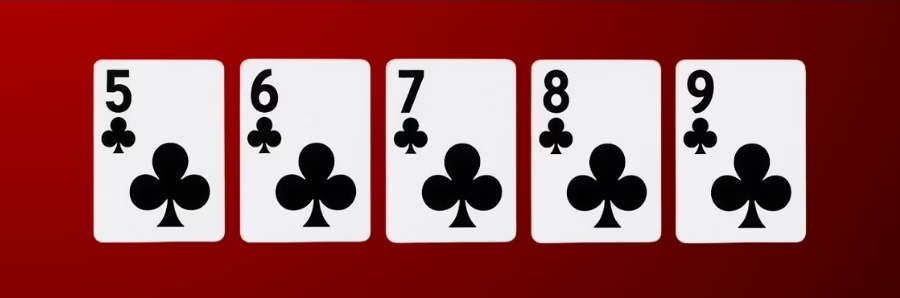
Five in a row, all one suit.
It is a straight and a flush at the same time, and the combination jumps over both categories. A five-six-seven-eight-nine of spades beats a flush, a full house, and four of a kind. Only a higher straight flush beats it.
Players sometimes describe this as “a straight that also flushed.” That undersells it. It is its own row on the chart, two places above a plain straight.
5. Royal Flush
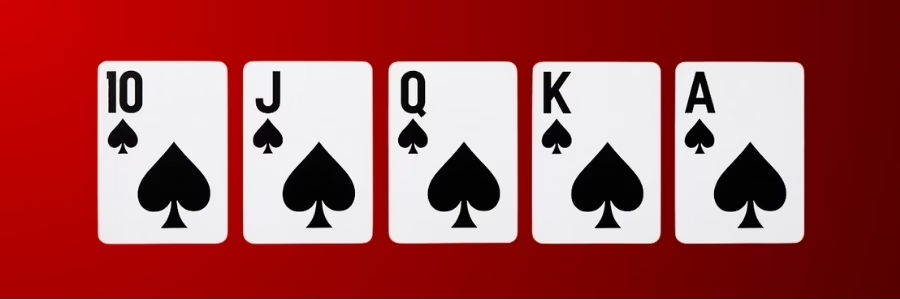
Ace-king-queen-jack-ten of one suit.
It is not a separate species of hand. It is the highest straight flush, and the highest hand in standard high poker. Nothing beats it. A royal flush in a different suit does not beat it either. The two split.
You will almost never need this rule. It is still the top of the list, so it belongs in the answer.
What a straight is, and what it is not
Five ranks in sequence. The suits can be anything, as long as they are not all the same. If they are all the same, the hand has been promoted. It is a straight flush, and it no longer lives in the straight row.
The Ace can go high or low
The ace is the only card that moves. It can sit above the king, so ace-king-queen-jack-ten is a straight, usually called broadway. It can sit below the deuce, so ace-two-three-four-five is a straight, usually called the wheel.
It cannot do both jobs at once.
- King-ace-two-three-four is not a straight.
- Queen-king-ace-two-three is not a straight.
The sequence does not wrap around the ace.
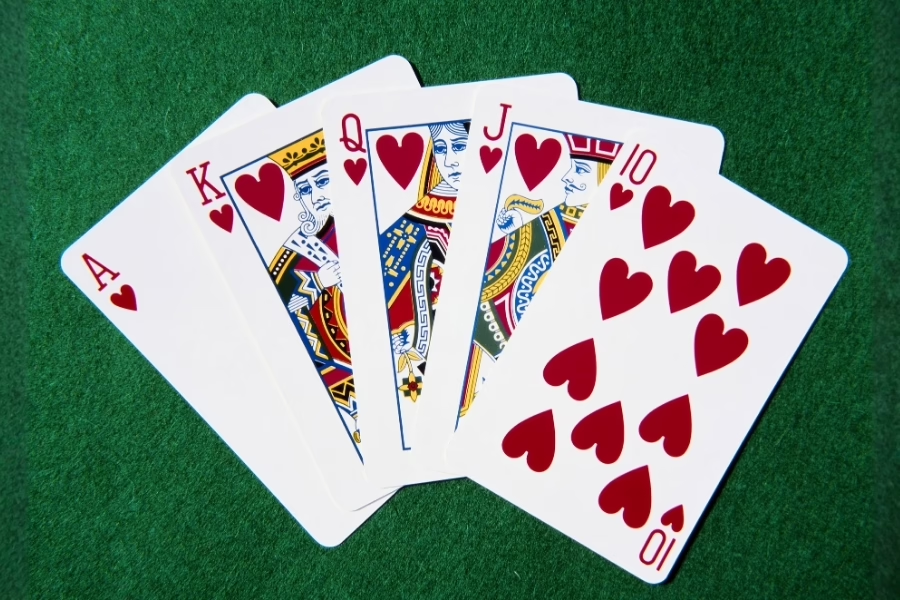
A draw in not a made straight
A four-card run is not a straight. A straight draw is not a straight. Four to a straight on the flop is a draw. It needs the fifth card.
A player who says they “had a straight” with eight-nine-ten-jack and a blank river is describing a draw that missed.
Duplicate ranks break the sequence
Seven-eight-eight-nine-ten is not a straight. It is a pair of eights with three side cards. The extra eight does not fill the gap where a six or a jack should be.
You also cannot build a straight out of six cards and then pick the parts you like. The hand is the best five.
What a straight beats
Three of a kind loses to a straight. This is the second most common argument at a home game, after flush versus straight. A set of aces feels enormous. It is enormous against one pair and two pair. It is not enormous against five connected cards.
Pocket aces that flop a set on ace-seven-two still lose if a player makes a straight and nobody makes a flush or a full house.
Two pair loses. Aces and kings, the best two pair you can hold on many flops, lose to a six-high straight. One pair loses. Ace high loses. There is no kicker contest between a pair and a straight. The straight has already won before the side cards are compared.
The key rule: The only time a pair “beats” a straight is when the pair is part of a better hand.
A pair on the board that becomes a full house is no longer a pair. Quads are no longer a pair. Name the five-card hand, not the hole cards.
When two straights meet
The straight with the higher card at the top wins. A jack-high straight beats a ten-high straight. Broadway beats every other straight. The wheel loses to every other straight, including six-high, which is the next one up: two-three-four-five-six.
There is no kicker once both players are using the same five ranks. If the board is ten-jack-queen-king-deuce and both players hold an ace, both have broadway. The other hole card is irrelevant. A player with ace-nine and a player with ace-three split the pot.
When the board plays
The board can play in Hold’em. If the five community cards are already a straight, and neither player can make a better hand, the pot is chopped. A player with two random cards does not lose to a player with two other random cards. Both are playing the board.
A higher straight that uses a hole card beats the board straight.
Example
Board: six-seven-eight-nine-deuce.
The board straight is nine-high. A player with a ten has a ten-high straight and wins the whole pot. A player with a five has the same nine-high straight as the board, and loses to the ten.
Hold’em uses the best five cards out of seven. You do not have to use both hole cards. You do not have to use either. That is why the board can play, and why a pocket pair does not automatically count if five better cards are sitting on the table.
Worked hands
Rankings are easier to trust after you watch them on a board. These are ordinary showdown spots, not trick questions.
Example 1: The Higher Straight Takes It
Board: 9♣ 8♦ 7♠ 5♥ 2♣
- Player A: 6♦ K♠ — a nine-high straight, five through nine.
- Player B: J♥ 10♥ — a jack-high straight, seven through jack.
Winner: Player B.
The king in Player A’s hand is not a kicker against a higher straight. It is a spare card.
Example 2: The Nut Straight Still Loses to a Flush
Board: J♥ 10♥ 9♥ 3♣ 2♦
- Player A: Q♠ 8♠ — a queen-high straight, the best straight available.
- Player B: A♥ 4♥ — an ace-high flush.
Winner: Player B.
Player A had the nut straight and still lost, because a flush was possible and it arrived. “Nut straight” means the best straight. It does not mean the best hand.
Example 3: Trips Lose, a Boat Does Not
Board: J♥ 10♥ 9♣ 9♦ 2♠
- Player A: Q♠ 8♠ — a queen-high straight.
- Player B: 9♠ 4♣ — three nines, and no pair to go with them.
Winner: Player A.
Trips lose to a straight. Give Player B a deuce as well, so the hole cards are 9-2, and the hand becomes nines full of deuces. That full house wins.
The nine did not get stronger by feeling stronger. The five-card hand changed.
Example 4: A Straight Flush Jumps the Line
Board: 8♠ 7♠ 6♠ 5♦ 2♥
- Player A: 9♣ 4♦ — a nine-high straight.
- Player B: 4♠ 9♠ — an eight-high straight flush, using 4-5-6-7-8 of spades.
Winner: Player B.
The straight flush wins. It also beats any full house and any four of a kind that might have been in the hand. The plain straight never has a claim.
Why the chart is built this way
The order is not etiquette and it is not house style. It tracks how hard the hands are to make from a 52-card deck, counted as five-card combinations.
| Hand | Five-card combinations | Approximate frequency |
|---|---|---|
| Straight | 10,200 | 1 in 255 |
| Flush, excluding straight flushes | 5,108 | 1 in 509 |
| Full house | 3,744 | 1 in 694 |
| Four of a kind | 624 | 1 in 4,165 |
| Straight flush | 40 | 1 in 72,193 |
| Royal flush | 4 | 1 in 649,740 |
Those counts are for five-card poker, where every hand is exactly five cards. Hold’em deals seven cards and asks you to pick the best five, so you will see straights more often than those odds suggest. The ranking does not change. The game still scores the five-card hand, and the five-card hand still follows the same order.
A useful check when a table starts inventing rules: ask which hand is harder to make. In a full deck, a flush is harder than a straight, a full house is harder than a flush, and quads are harder than a full house.
A home-game ruling that flips any of those is not a local variant. It is a mistake. Lowball games are the real exception, and they are a different game, not a ruling on this one.
When a straight is the nuts
The nuts is the best hand anyone can hold on this exact board. A straight is the nuts only when every hand above it is impossible.
No flush can exist in Hold’em unless the board has three cards of one suit. A two-tone flop can make a flush by the river. Four different suits across five board cards means no flush.
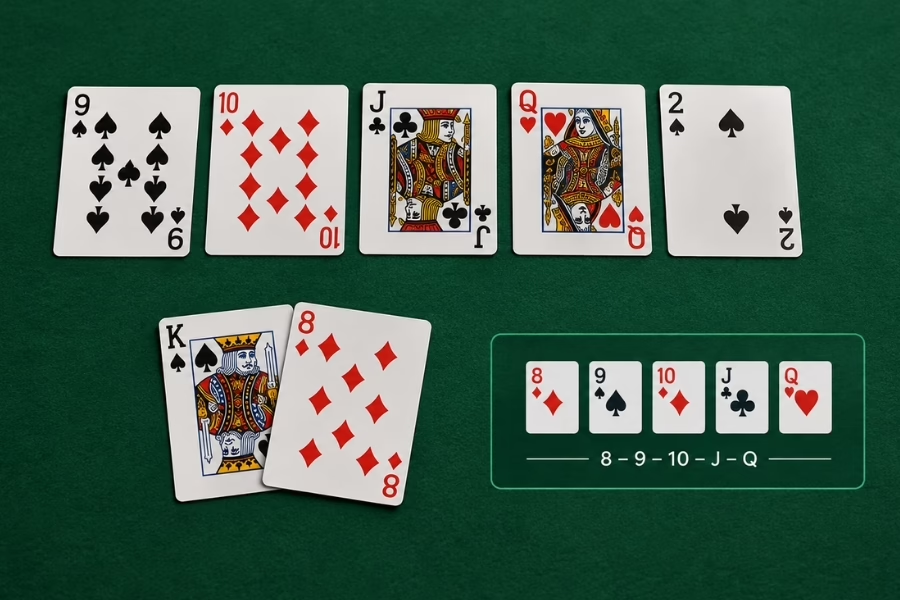
No full house or quads can exist on an unpaired river, because a boat needs the board to pair, or a player to hold a pocket pair while the board pairs a different rank. At the river, an unpaired board means nobody has a full house, and nobody has quads.
So on a rainbow, unpaired river such as 8-9-10-J-2 with no three cards of one suit, anyone with a queen and king has the nuts. They beat with every other queen. If a flush is possible, the nut straight is not the nuts. It is a strong hand that loses to a flush.
This is the spot where players stack off and then say they got coolered. Sometimes they did. Sometimes they bet as if a straight could not lose on a three-flush board.
The same test applies one street earlier. A straight on the flop of 9-8-7 rainbow is often the nuts at that moment when you are holding 10-J. It stops being the nuts if the turn pairs the board, or if a third heart arrives and someone can hold two hearts.
“I had the nuts on the flop” is a description of the flop. It is not a description of the river.
Draws are not straights yet
You do not have a straight until the fifth card arrives.
An open-ended straight draw is four connected cards with both ends open, such as 6-7-8-9, which completes with a five or a ten. That is eight outs in a full deck.
From the flop, eight clean outs arrive on the next card about 17 percent of the time, and by the river about 31 or 32 percent of the time.
A gutshot misses the inside card, such as 6-7-9-10 missing an eight. That is four outs: about 8.5 percent on the next card, about 16.5 percent by the river.
Those percentages assume the outs are clean. A straight-completing card that also completes a flush for someone else is not a clean out. You may still improve to a straight and lose. Counting the out without counting the board is how a straight draw becomes an expensive call.
Hold’em, Omaha, and Stud
The ranking is the same in Texas Hold’em, Omaha, Omaha hi-lo for the high side, seven-card stud, and five-card draw. A flush beats a straight in all of them. What changes is which cards you are allowed to use.
Hold’em and Stud
In Hold’em and stud, you choose the best five cards you were dealt. The board, or the up cards, can be your whole hand.
Omaha and Omaha Hi-Lo
In Omaha and Omaha hi-lo, you must use exactly two hole cards and exactly three community cards. A straight lying on the board is not your hand. You cannot play all five community cards. You might still have a straight, but only if two of your hole cards combine with three board cards to make one.
This rule creates a famous error. The board reads 5-6-7-8-9. In Hold’em, everyone can play that straight and the pot is often chopped. In Omaha, nobody has that straight unless two hole cards actually build a straight with three of those cards.
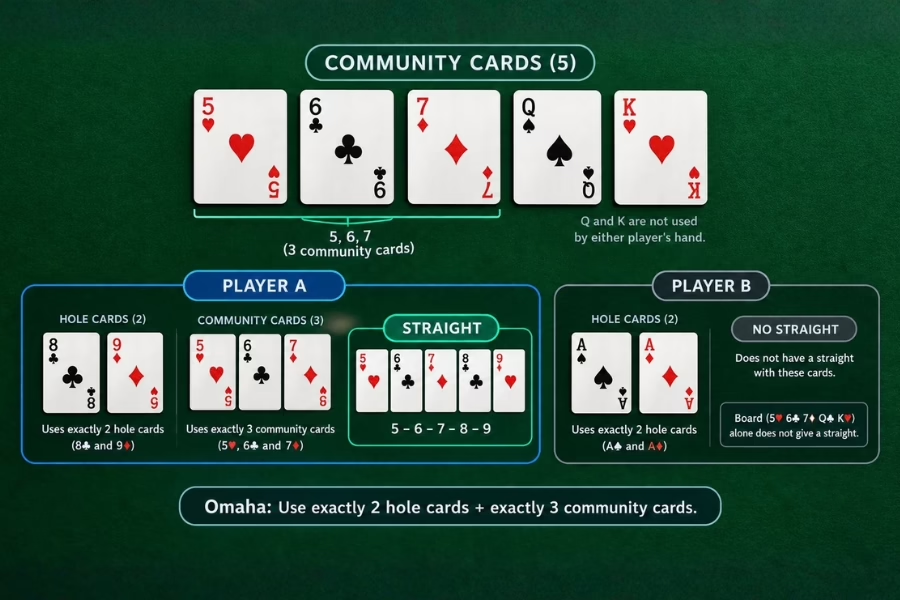
A player with 8-9 has a straight. A player with a pair of aces and nothing connected does not. Saying “the board is a straight” in an Omaha pot is not a claim on the pot.
Hi-lo games do not change the high ranking. A wheel can win the high, the low, or both, depending on the low qualifier and on what else is out. For the high side, ace-two-three-four-five is still the lowest straight, and it still loses to a flush.
A player who scoops with a wheel has not discovered a new ranking. They have won the low, and they have also won the high because nobody held a better high hand.
Short deck is the exception worth naming
Short-deck poker, also called six-plus, removes the deuces, treys, fours, and fives. The deck has 36 cards. Because the deck changed, the rarity of the hands changed, and many rooms change the ranking to match.
In the version used in most short-deck games, a flush beats a full house. Flushes became harder than full houses once four cards left each suit. A straight still loses to a flush in that version. It still loses to quads and to a straight flush.
The ace-low straight becomes ace-six-seven-eight-nine, since two-three-four-five no longer exist. Broadway is unchanged.
A few rooms also rank three of a kind above a straight. That is a house rule, not the standard full-deck rule, and it is not universal even in short deck. Other tables keep the ordinary order, with a straight beating trips.
If you sit in a short-deck game, ask before the first hand. If you are playing a normal deck, trips do not beat a straight, and a flush does not lose to a full house.
How to think about the hand once you have it
A made straight is a value hand on a dry board and a cautious hand on a wet one. The question is not whether a straight is good in the abstract. It is whether a better hand can exist on this board, and whether a worse hand will pay you.
On a rainbow, unpaired board
On a rainbow unpaired board, bet. Players with top pair, two pair, and sets will often call, and all of those hands lose. Slow-playing the nut straight on a dry board mostly lets the deck catch up, or lets the table check it down. The chart says you are ahead of those hands. The bet is how you get paid by them.
On a two-flush board
On a two-flush board, a straight is still often the best hand, and it is no longer close to invulnerable. A player who called the flop with one heart and peeled a heart on the river has you beat if they hold the second heart.
You can still value bet against sets and two pair. You should not stack off as if you hold the nuts when the third heart arrives and you do not hold a heart.
On a paired board
On a paired board, the same logic applies to full houses. Your straight was good on the flop of 9-8-7. The turn is a nine. Any nine, any pocket pair, and any eight or seven that paired now has a boat, or trips that might improve.
You still beat bare trips. You do not beat the boat. Betting small to get called by a pair is different from calling off a shove against a range that is now full of boats.
When your straight is a bluff-catcher
The straight is also a bluff-catcher in some lines and a value hand in others. Against a large river bet on a four-straight board, you are often beating a missed draw that turned into a bluff, and losing to the higher straight or the flush.
Rank the hand against the range, not against the chart alone. The chart tells you the flush wins. It does not tell you whether this opponent has the flush.
Mistakes that cost pots
Most of these are ranking errors. A few are card-use errors. All of them show up in real pots.
- Calling the wheel a high straight. Ace-two-three-four-five is the lowest straight in a full deck. It loses to two-three-four-five-six, and it loses to everything above that.
- Playing the ace as a wrap. King-ace-two-three-four is ace high. It is not a straight. The ace moved. It did not bend the chart around itself.
- Using six cards. A player who says they have a straight and a pair is describing either a straight or a full house, not both. If the five cards in a row are the best five, the pair is not part of the hand.
- Assuming the higher kicker wins between two equal straights. It does not. Equal five-card straights split. The spare card is spare.
- Assuming a set of aces is the nuts on a connected board. It is not even ahead of a straight. It is ahead of two pair.
- Forgetting that a straight flush is its own category. If you made it, you do not lose to a full house. If someone else made it, your straight is drawing dead.
- Importing a short-deck rule into a full-deck game. A flush beating a full house is a six-plus rule. It is not a Hold’em rule. Trips beating a straight is not a Hold’em rule either.
Lowball is a different game
None of this applies unchanged to lowball. In razz and in ace-to-five low, the point is to make the lowest hand, and a straight is not a penalty in ace-to-five. In deuce-to-seven lowball, straights and flushes count against you, so a straight is a bad hand rather than a good one.
If the game is high poker, or the high side of a hi-lo game, ignore those rules. A straight is a high hand, and the five hands above it still beat it.
The short version
Five hands beat a straight: a flush, a full house, four of a kind, a straight flush, and a royal flush. A straight beats three of a kind, two pair, one pair, and high card. Between two straights, the higher top card wins, the wheel is the lowest, and identical straights split. The ace moves. It does not wrap. In a full-deck game those rules do not have a local exception.
If the board can hold a flush or a full house, the straight is still strong, and it is not the nuts. Bet it when worse hands can call. Respect it when the board has changed the chart under you.
The hand did not get worse because you played it badly. The board offered a better five cards to someone else.


