What Is Short Deck (Six-Plus) Poker?

Short Deck Poker, also known as Six-Plus Hold’em or 6+ Hold’em, is a dynamic variant of Texas Hold’em that strips the deck down to 36 cards and flips several traditional hand rankings.
Designed to generate more action and narrower equities, the game has become a favorite among high-stakes professionals and recreational players who prefer nonstop pots and dramatic swings.
Unlike standard No-Limit Hold’em, Short Deck:
- Removes the lowest cards.
- Changes how certain hands rank.
- Often uses a unique ante-and-button-blind structure.
These adjustments create more starting hands that connect, more frequent strong holdings, and a playing style that rewards aggression while punishing overly tight play.
How the Short Deck Works
In standard poker, a full deck contains 52 cards. Short Deck removes every 2, 3, 4, and 5 from the deck—16 cards in total—leaving exactly 36 cards: the ranks 6 through Ace in all four suits.
What Changes When the Deck Gets Shorter?
| Feature | Effect |
|---|---|
| Cards per suit | There are only nine cards per suit instead of thirteen, making flushes significantly harder to complete. |
| Number of ranks | There are only nine ranks instead of thirteen, so pairs, trips, and full houses occur more frequently. |
| Straights | Straights become easier because the range of possible connecting cards is compressed. |
The Ace and the Wheel Straight
The Ace still plays both high and low.
- Highest straight: 10-J-Q-K-A
- Lowest straight: A-6-7-8-9
The Ace effectively acts as a 5 in the lowest straight. This “wheel” is a common source of confusion for players new to the format.
Modified Hand Rankings
Because the shorter deck changes the probability of making certain hands, the ranking order is adjusted.
The most important differences are:
- A flush now beats a full house.
- In most modern versions, a straight still beats three of a kind.
- Some early and regional variations reverse the order of a straight and three of a kind.
Standard Short Deck Hand Rankings
Highest to lowest:
| Rank | Hand | Example |
|---|---|---|
| 1 | Royal Flush | A♥ K♥ Q♥ J♥ 10♥ |
| 2 | Straight Flush | K♠ Q♠ J♠ 10♠ 9♠ or A♦ 9♦ 8♦ 7♦ 6♦ |
| 3 | Four of a Kind | Q♥ Q♦ Q♣ Q♠ 8♥ |
| 4 | Flush | A♣ K♣ 10♣ 8♣ 6♣ |
| 5 | Full House | J♦ J♠ J♥ 7♣ 7♦ |
| 6 | Straight | 10♠ 9♥ 8♦ 7♣ 6♥ or A♠ 9♦ 8♥ 7♣ 6♠ |
| 7 | Three of a Kind | K♥ K♦ K♠ Q♣ 8♥ |
| 8 | Two Pair | A♦ A♠ 9♥ 9♣ K♦ |
| 9 | One Pair | Q♠ Q♥ J♦ 10♣ 7♥ |
| 10 | High Card | A♠ K♦ Q♥ 10♣ 7♠ |
Note: Always confirm the exact ranking order and blind structure with the room or site before playing, as minor variations exist.
Betting Structure and Antes
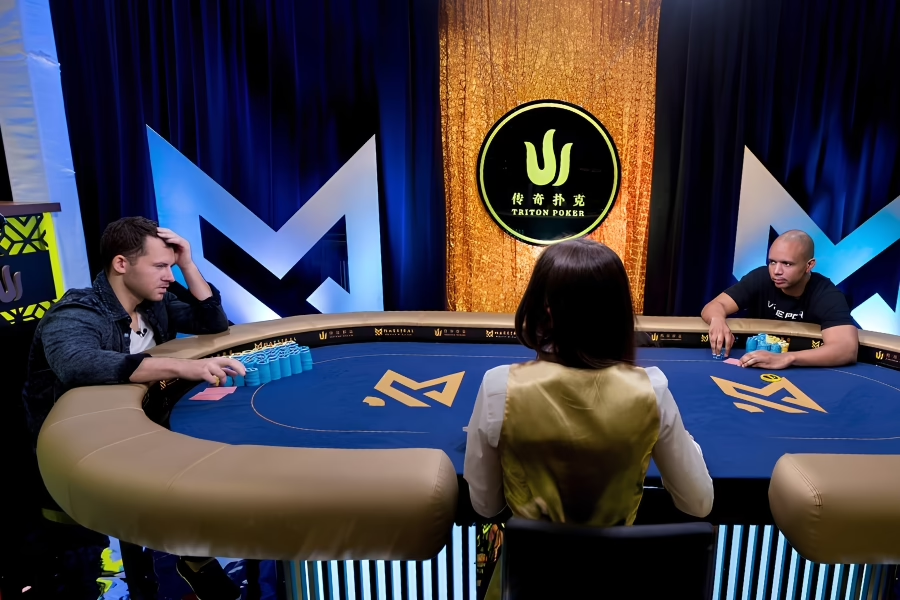
While some games simply use standard small and big blinds, many Short Deck cash games and tournaments—especially those popularized by the Triton Poker Series—use a different structure:
- Every player posts an ante.
- Only the player on the button posts a blind, often equal to the ante or larger.
This creates a larger preflop pot relative to the stakes and puts constant pressure on the button.
The result is:
- More frequent preflop raising.
- More multi-way pots.
- Fewer walks.
Because equities run closer together than in full-deck Hold’em, players are more willing to put stacks in the middle with a wide range of hands.
Why Short Deck Creates More Action
The mathematical design of Short Deck deliberately compresses hand equities and increases the frequency of strong holdings.
Key Reasons for the Increased Action
- More playable starting hands: Premium pairs and suited connectors are more common, so players enter more pots.
- Different flush-draw dynamics: Flush draws have fewer outs (only five remaining suited cards instead of nine), making them less dominant when they complete.
- More frequent full houses and sets: Full houses and sets appear more often, but they no longer automatically beat flushes.
- Larger preflop pots: The larger preflop pot from antes forces more continuation betting and multi-street decisions.
High-stakes professionals who helped popularize the game, including Tom Dwan, Phil Ivey, and Jason Koon, frequently noted that the format levels the playing field between experienced pros and wealthy recreational players by increasing the variance and reducing the edge of ultra-tight play.
History and Popularization
Short Deck emerged in the high-stakes private games of Macau around 2014–2015.
Malaysian businessman and poker enthusiast Paul Phua, along with Richard Yong, are widely credited with formalizing the rules. Their goal was to create more action and give recreational players a better chance against professionals in ultra-high-stakes cash games.
Major Milestones
- 2014–2015: Short Deck emerged in high-stakes private games in Macau.
- 2018: The Triton Poker Series held the first major televised Short Deck events, bringing the format to a wider poker audience.
- 2019: The World Series of Poker added a $10,000 Short Deck No-Limit Hold’em bracelet event, further legitimizing the variant.
- Around the same period: Online rooms including GG Poker introduced “6+ Hold’em” cash games and tournaments.
The format drew early interest from elite players such as Phil Ivey and Tom Dwan.
While Short Deck never displaced traditional Hold’em as the dominant form of poker, it remains a popular high-stakes option, particularly in Asia and in high-roller series. It continues to appear in select Triton events and on several online platforms.
Basic Strategy Adjustments
Players transitioning from standard Hold’em need to adjust several key concepts.
1. Play More Hands
The higher frequency of strong starting hands and the larger dead money from antes make tight ranges unprofitable.
2. Value Suited Hands Highly
Because a flush beats a full house, suited cards gain significant value, especially suited aces and kings.
3. Respect the New Rankings
Never assume a full house is the nuts when a flush is possible.
Similarly, remember that A-6-7-8-9 is a straight.
4. Size Bets Larger and Apply Pressure
Closer equities and bigger pots reward aggressive play and well-timed bluffs.
5. Account for the Button
In button-blind formats, the button has already invested chips and often has position and a discount on calling raises.
Conclusion
Short Deck (Six-Plus) Poker is more than a novelty—it is a carefully engineered variant that deliberately increases action, variance, and excitement while preserving the core skill elements of Texas Hold’em.
By removing the lowest cards, adjusting hand rankings so that flushes outrank full houses, and often using antes with a button blind, the game creates a faster, more volatile experience that appeals to both professionals and recreational players.
Whether you encounter it in a high-stakes Triton cash game, an online 6+ table, or a special tournament event, understanding the modified deck, the new hand hierarchy, and the strategic implications will help you adapt quickly and enjoy one of poker’s most action-packed formats.


