What Is Position in Poker?

Position is one of the most important concepts in poker. Acting later gives you a clear advantage because you see how other players bet, call, raise, or fold before you decide.
This information edge lets you play more hands profitably, control pot size more effectively, and make better bluffs and value bets. In short, the later your position, the stronger your strategic edge.
The Different Positions at the Table
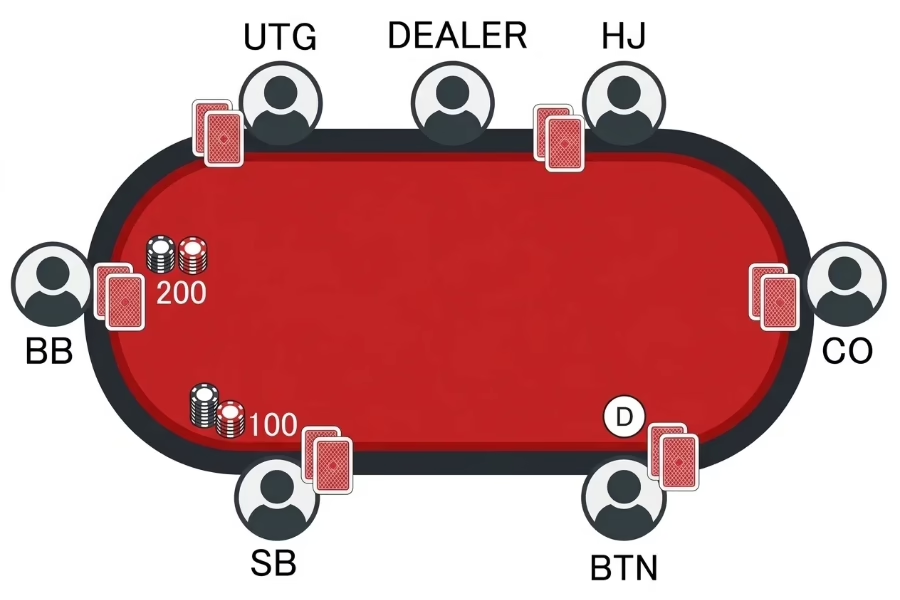
Positions are labeled based on their relationship to the button. Most cash games and tournaments are played either full-ring (usually 9 players) or short-handed (6-max). The exact names can vary slightly, but the concepts remain the same.
| Position | Seats | Description |
|---|---|---|
| Early Position (EP) | Under the Gun (UTG) and the seats immediately to its left (UTG+1, sometimes UTG+2) | These players act first preflop and early in postflop betting rounds. |
| Middle Position (MP) | The seats between early and late position | You have more information than early position but still face several players yet to act. |
| Late Position (LP) | Hijack (HJ), Cutoff (CO), and Button (BTN) | These are the most profitable seats because you act last or near last. |
| Blinds | Small Blind (SB) and Big Blind (BB) | You post forced bets. Preflop you act last (or near last), but postflop you act first, which is a significant disadvantage. |
Why Position Matters So Much
Good players treat position as a primary factor in every decision. Here are the main reasons it creates such a large edge:
- Information advantage: When you act last, you already know who has shown strength, who has checked, and who has folded. This reduces the range of hands your opponents can have and makes your decisions more accurate.
- Pot control: In position you can choose to keep the pot small with medium-strength hands or build it when you are strong. Out of position, opponents can force larger pots when they want.
- More effective bluffs: Bluffing works better when opponents have already acted and shown weakness. You can also bluff more frequently because you have the initiative and the information edge.
- Better value betting: You can size bets more precisely once you have seen how opponents respond, extracting maximum value from weaker hands.
- Higher equity realization: Speculative hands such as suited connectors and small pairs realize far more of their equity when you can see how the hand develops before committing chips.
How to Play from Early Position
Early position is the most difficult seat. You act first and will face raises, 3-bets, and multiway pots with little information. For this reason, strong players open only premium hands from early position.
Typical early-position opening ranges include:
- High pairs (AA–99 or TT).
- Strong suited aces (AKs, AQs, AJs).
- The best broadways (AKo, AQo, KQs).
Speculative hands like 76s or 55 lose a lot of their value because you will often be forced to play them multiway and out of position.
When you do open from early position, be prepared to face resistance. A significant portion of your opens will be 3-bet, and you must have a clear plan for continuing or folding against those raises.
Middle Position Strategy
Middle position sits between the extremes. You have more information than early position, but several players still act after you.
Ranges can open slightly wider than early position while remaining disciplined. You can add more suited connectors, medium pairs, and some suited aces that you would fold from UTG.
However, you should still avoid the very weakest hands that only become profitable when you are guaranteed to act last.
Late Position: Cutoff and Button
Late position is where most of the long-term profit is made. From the cutoff and especially the button, you can open a much wider range because fewer players remain to act and you will have position postflop against the blinds.
The button is the single best seat in poker. You act last on every postflop street when heads-up against the blinds, and you can profitably steal with a very wide range.
Many winning players open 40–50% or more of hands from the button in cash games, depending on the table and blind defense tendencies.
From late position you should also look for opportunities to:
- Isolate limpers.
- 3-bet light against weak opens.
- Take control of the pot postflop.
The combination of a wider range and positional advantage makes these seats highly profitable.
Playing from the Blinds
The blinds are unique. You are forced to put money in the pot before the hand starts, which creates incentive to defend. However, you will almost always be out of position postflop.
- Big Blind: Gets the best price to see a flop and can defend a reasonably wide range, especially against late-position opens.
- Small Blind: The most difficult position of all. You have already invested a partial blind, but you act first postflop against the big blind and any other callers.
Against late-position raises, both blinds should defend more often than against early-position raises. Still, calling too wide out of position leads to difficult postflop decisions and is a common leak for many players.
Position and Range Construction
Your opening range, calling range, and 3-betting range should all change dramatically based on position.
- Early-position ranges are tight and linear (strong hands).
- Late-position ranges are wider and can include more speculative holdings because the positional advantage compensates for lower raw hand strength.
The same principle applies postflop. In position you can continue with a wider range of hands on the flop and turn because you can control the action.
Out of position you should generally play tighter and more straightforwardly.
Common Mistakes with Position
- Opening too many hands from early position and then struggling multiway or out of position.
- Folding too often from the button and cutoff, missing profitable steal and isolation opportunities.
- Calling raises from the blinds with hands that play poorly out of position.
- Ignoring remaining players’ positions when deciding whether to continue or fold postflop.
- Playing passively in position and failing to take advantage of the information edge.
Key Takeaways
- Position is the order of action determined by your seat relative to the dealer button.
- Acting later provides more information, better pot control, and more effective bluffs and value bets.
- Early position requires tight ranges; late position (especially the button) allows much wider and more aggressive play.
- The blinds must defend selectively because they will be out of position for the rest of the hand.
- Your entire strategy—opening ranges, continuation frequencies, and bet sizing—should adjust based on position.
Mastering position is one of the highest-leverage skills in poker. Players who consistently adjust their ranges and aggression according to their seat win more money over the long run, even with the same starting hands as everyone else.
Always know where you sit, how many players remain to act, and what that means for the strength of your range before you put chips in the pot.