What Is a Blocker in Poker?

In modern poker strategy, especially in No-Limit Hold’em and Pot-Limit Omaha, the concept of blockers has become essential for advanced decision-making.
A blocker is a card in your hand that reduces the number of combinations of certain strong hands your opponent can hold.
By removing specific cards from the deck, you change the probability distribution of your opponent’s range. This can turn marginal bluffs into profitable ones or help you make better calls.
Understanding blockers allows players to:
- Select the best hands for bluffing.
- Identify the strongest bluff-catchers.
- Construct more accurate ranges.
While the idea is simple, its application requires a solid grasp of combinatorics and range construction.
What Exactly Is a Blocker?
A blocker is any card you hold that makes it impossible or less likely for your opponent to have a particular hand.
Because poker hands consist of specific combinations of cards, holding one of those cards removes those combinations from your opponent’s possible holdings. This effect is known as card removal.
Every card you can see—whether in your hand or on the board—is a card your opponent cannot have.
The most powerful blockers are usually high cards that interact with the strongest possible made hands on a given board, such as the Ace of the suit that completed a flush.
Blocker vs. Blocker Bet
| Term | Meaning |
|---|---|
| Blocker | A card-removal effect caused by a card in your hand. |
| Blocker bet | A small, strategic bet designed to control the pot size or induce a check-back. |
How Blockers Work: Combinatorics Basics
Poker ranges are made of combinations, not just hand names.
Here are some examples of how holding a particular card reduces your opponent’s possible combinations:
| Hand | Original combinations | After holding one relevant card |
|---|---|---|
| Pocket Aces (AA) | 6 | 3 |
| Ace-King (AK) | 16 | 12 |
| Nut flush | Limited combinations | Eliminated by holding its Ace |
For pocket Aces, holding one Ace removes three of the six possible combinations. That is a 50% reduction.
For unpaired hands such as Ace-King, there are normally 16 combinations. Holding one Ace reduces this to 12 combinations.
On a board with three cards of the same suit, the nut flush typically has a limited number of combinations. Holding the Ace of that suit eliminates the nut flush entirely.
These reductions become more significant as the hand progresses and ranges narrow.
On the river, when few combinations remain relevant, a single well-chosen blocker can dramatically shift the equity of a bluff or a call.
Classic Blocker Examples
Example 1: The Nut Flush Blocker
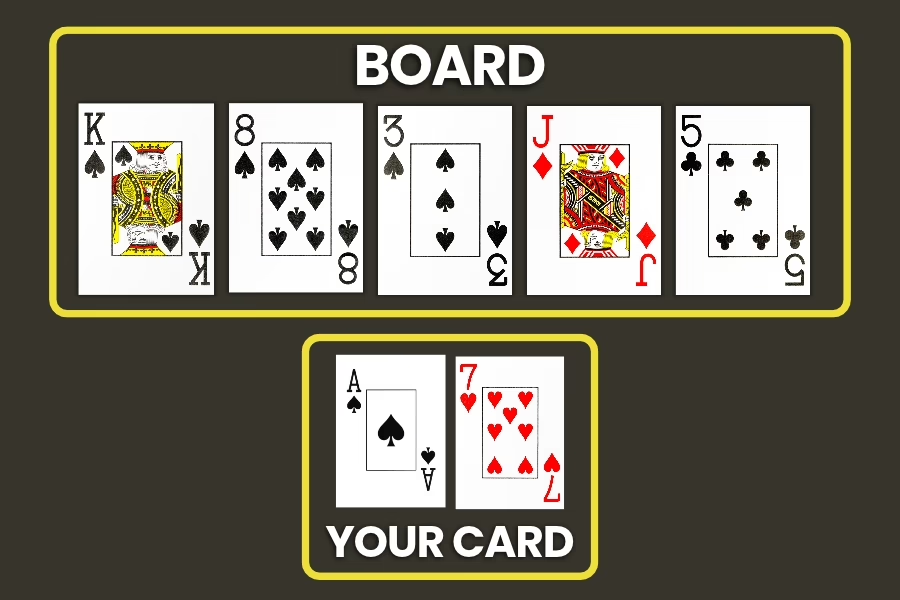
Your Ace of spades is a pure nut blocker—your opponent cannot hold the nut flush.
This makes bluffing with this hand far more attractive than bluffing with a hand that does not contain the Ace of spades.
Example 2: Blocking Pocket Aces
Board: A♥ K♦ 7♠ 2♣ 9♥
Your hand: A♦ Q♠
You block three of the six combinations of pocket Aces.
Your opponent is significantly less likely to hold the strongest possible overpair.
Example 3: Blockers in Pot-Limit Omaha
In Pot-Limit Omaha, blockers are even more critical because players hold four cards.
Nut blockers (such as the Ace of the flush suit) or blockers to the nut straight frequently determine whether a large river bet is a value bet or a bluff.
Using Blockers When Bluffing
The primary strategic use of blockers is selecting which hands to use as bluffs.
The best bluffing candidates are hands that:
- Block your opponent’s strongest calling hands.
- Leave their folding hands unblocked.
Ideal bluffing blockers remove the top of your opponent’s value range.
Example: Holding the Ace of the completed flush suit is the textbook example.
Holding a King when the board pairs the King can also reduce the number of sets or two-pair combinations your opponent can call with.
What About Reverse Blockers?
Conversely, hands that block the cards your opponent would fold with (sometimes called “unblockers” or reverse blockers) are generally poor bluffing candidates.
You want your opponent to still have as many folding hands as possible when you bluff.
Using Blockers When Calling
When deciding whether to call a bet, especially a large river bet, you want hands that:
- Block your opponent’s value combinations.
- Leave their bluffs unblocked.
This increases the proportion of bluffs in their betting range.
For example, if your opponent is representing a nut flush, calling with a hand that contains a card of that suit (but not the Ace) makes it slightly more likely they are bluffing, because you have removed some of their flush combinations.
The effect is usually smaller than pure nut blockers, but it can still tip close decisions.
Hands that do not block your opponent’s bluffs (unblockers for bluffs) are preferred for bluff-catching.
You want as many of their bluffing combinations as possible to remain available.

When Blockers Matter Most
Blockers have the greatest impact on the river, when ranges are narrowest and the number of relevant combinations is small.
Their importance changes throughout the hand:
| Street | What matters most |
|---|---|
| Flop | Equity, range advantage, and board texture usually dominate decision-making. |
| Turn | Blockers begin to matter more. |
| River | Blockers can be the deciding factor between two otherwise similar hands. |
They are also more powerful in:
- Heads-up pots: Where the opponent’s range is easier to narrow down.
- Well-defined ranges: Against opponents whose ranges are well-defined.
In multiway pots or against players who play many weak hands, the combinatoric effect is diluted.
Common Mistakes with Blockers
1. Overestimating a Single Blocker
Holding the Ace of spades on a three-spade board does not mean your opponent cannot have a flush—it only removes the nut flush.
There may still be many lower flush combinations.
2. Bluffing Just Because You Have a Blocker
Another frequent error is using blockers as an excuse to bluff with weak hands that have poor equity or poor blockers.
Blockers improve already close decisions; they rarely turn a bad bluff into a good one.
3. Ignoring Reverse Blockers
Finally, players sometimes ignore the reverse effect.
A card that blocks your opponent’s folding range can make a bluff worse, not better.
Always ask whether the card removes hands that would call or hands that would fold.
Conclusion
A blocker in poker is a card you hold that removes combinations from your opponent’s range through simple card removal.
Mastering this concept improves both your bluffing frequency and your calling decisions, particularly on the river.
While blockers are not a magic solution, they provide a measurable edge in close spots once you understand which hands they affect and how much those hands matter in your opponent’s range.
By studying combinatorics and practicing with hand histories, players can learn to incorporate blockers naturally into their decision-making process and gain a significant advantage over opponents who ignore them.


