What Is a Continuation Bet (C-Bet) in Poker?

A C-bet is any flop bet by the last preflop aggressor (the open-raiser, three-bettor, or four-bettor).
Example:
You raise from the button with A♠ K♦ and the big blind calls. The flop is K♣ 7♦ 2♠. The big blind checks and you bet. That is a C-bet.
It is still a C-bet if the flop is 9♥ 6♦ 3♠ and you bet with nothing.
Why C-Bets Work
Most hands miss the flop; random unpaired hand hits a pair or better only about one-third of the time.
The preflop raiser also usually has a range advantage, especially on high-card boards.
Betting maintains initiative, generates fold equity, denies free cards, and builds the pot when you have strong hands.
A pure bluff needs the opponent to fold enough:
| Bet Size | Folds Needed to Break Even |
|---|---|
| One-third pot | About 25% |
| Half-pot | About 33% |
On dry boards, opponents often fold far more than this.
When to C-Bet
The three main factors are position, board texture, and number of opponents.
Position
- C-bet more often in position (often 60–80% heads-up on good boards).
- Tighten to about 40–50% out of position.
Board Texture
- Dry boards (K♠ 7♦ 2♣, A♦ 8♣ 3♥) favor frequent small C-bets.
- Wet boards (9♥ 8♥ 7♠, J♠ T♦ 8♠) favor fewer and larger bets.
Opponents
C-bets work best heads-up.
Multiway (3+ players), bet much less often and mostly for value or with strong draws.
Bet Sizing and Frequencies
- Use small bets (25–35% pot) on dry boards when betting a wide range.
- Use larger bets (65%+ pot) on wet boards to charge draws.
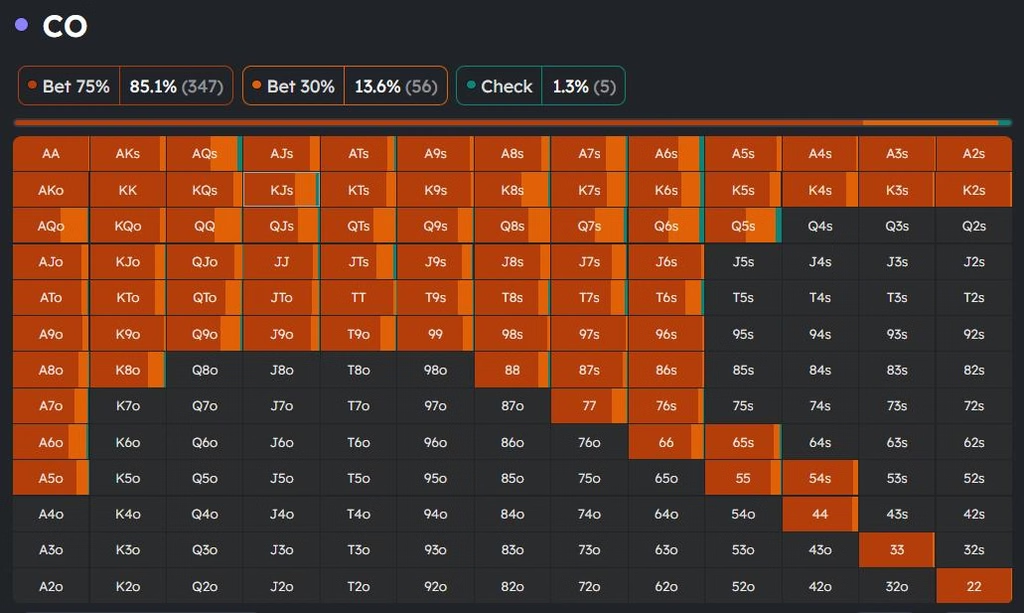
Common frequency ranges for single-raised pots:
| Situation | C-Bet Frequency |
|---|---|
| In position, dry board | 60–80% |
| In position, wet board | 50–65% |
| Out of position, heads-up | 40–50% |
| Multiway | Under 40%, value-heavy |
Value vs. Bluff C-Bets
Bet for value with strong hands (top pair or better, strong draws) that expect worse hands to call.
Bluff or semi-bluff with air or draws on boards that favor your range, especially when you have some equity if called.
If you cannot name hands that will call or fold, checking is often better.
When to Check
Check more often:
- Multiway.
- On wet or low connected boards that favor the caller.
- Out of position with medium hands.
- Against calling stations.
Occasional checks with strong hands also keep your range balanced.
Quick Examples
Good spot
Button raise with A♠ Q♦, big blind calls, flop A♣ 7♦ 2♠. Small C-bet is standard—dry board, top pair, in position.
Poor spot
Under-the-gun raise with K♣ Q♣, three callers, flop 9♥ 8♣ 7♦. Multiway and coordinated—check.
Common Mistakes
- C-betting every flop automatically.
- Using the same size on every board.
- Bluffing too often multiway or against calling stations.
- Checking only weak hands (unbalanced ranges).
Conclusion
A continuation bet is a powerful tool that converts the preflop aggressor’s range advantage into chips.
Adjust your frequency and sizing based on position, board texture, and the number of opponents rather than betting automatically.
Thoughtful C-betting wins more pots on the flop and sets up better decisions on later streets.