What are the Poker Hands Rankings?

The order that decides every pot, from a royal flush down to a lonely ace.
The short answer.
Ten hands, strongest first:
Royal flush → Straight flush → Four of a kind → Full house → Flush → Straight → Three of a kind → Two pair → One pair → High card
- Suits never outrank each other.
- Only the best five cards count.
- Aces can sit at the top of a straight or at the bottom, never both.
- One common exception: in short-deck poker, a flush beats a full house.
Every pot in poker ends the same way. Someone shows a five-card hand, and the ranking decides who takes the chips. The list is short. Learning the order takes an evening. Using it cleanly, especially when two players hold the same category and a kicker has to break the tie, takes longer.
The order is not a tradition someone invented for television. It tracks how rarely each hand appears in a 52-card deck. A royal flush is rarer than four of a kind. Four of a kind is rarer than a full house. A flush is slightly rarer than a straight, which is why a flush ranks higher, and why that one comparison starts more arguments than any other. Rarer means stronger. That is the whole system.
This is the standard high-hand ranking used in Texas Hold’em, Omaha high, seven-card stud, and five-card draw. It also covers the tiebreakers that settle most contested pots, the Hold’em rule that both players may be playing the board, and the variants that flip the list. Lowball games use a different scoring system. They are noted at the end, and they are not this list.
Why five cards, and why this order
Standard poker hands are five cards. Which five you can use depends on the game.
| Game | How you make your hand |
| Texas Hold’em | Choose the best five from your two hole cards and five community cards. |
| Omaha | Use exactly two cards from your hand and three from the board. |
| Five-card draw | Use the five cards you hold after the draw. |
| Seven-card stud | Make the best five from your seven private cards. |
The ranking itself does not change. What changes is which five cards you are allowed to use.
The Rarity Rule
There are 2,598,960 possible five-card hands in a 52-card deck. Only four of them are royal flushes. More than half are high-card hands, the weakest category.
Between those extremes the order follows the count. Players sometimes feel that a straight should beat a flush, because a straight looks more constructed. The deck disagrees.
- There are 10,200 straights.
- There are 5,108 flushes, once straight flushes are set aside.
Fewer flushes, higher rank.
Suits Never Break a Tie
A flush in spades does not beat a flush in hearts. A pair of aces with a spade kicker does not beat the same pair with a heart kicker.
If the five cards are equal in rank, the pot is split. Some home games invent a suit order so that someone always wins. Casino poker and tournament poker do not. A chopped pot is a normal result, not a failure of the rules.
The ten hands, strongest first
Read each hand as five cards, not as a nickname. The nickname is a shortcut. The five cards are the hand.
1. Royal flush
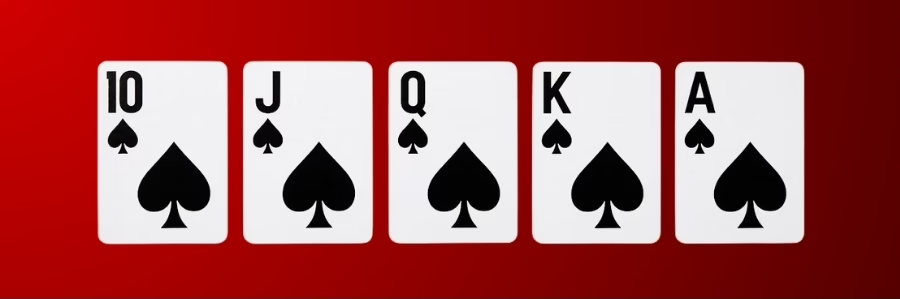
The ace, king, queen, jack, and ten of one suit. It is a straight flush topped by an ace, and it is the best hand in the game. There are four of them, one per suit. No kicker applies, and no royal flush beats another. If two players both hold one — possible in Hold’em when the board already shows the king through ten of one suit and each player holds the ace of that suit — they split the pot.
A royal flush is so rare that most players go years without seeing one. In a random five-card hand the chance is 1 in 649,740. In Texas Hold’em, where each player uses the best five of seven cards, it still shows up in roughly 1 of every 30,000 hands. Treat it as a fact of the ranking, not as a plan. Chasing it because the board has three to a royal is how a lot of chips move the other way.
2. Straight flush
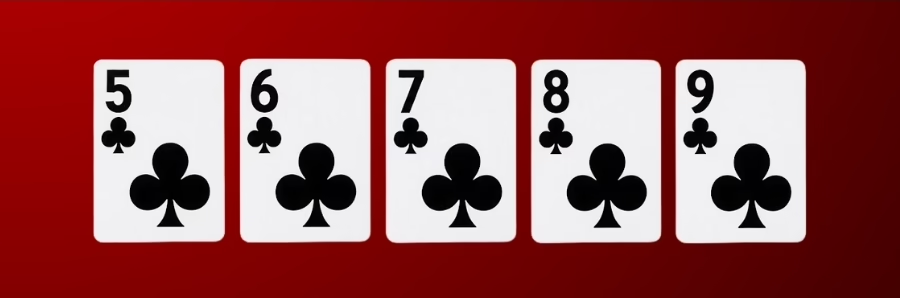
Five cards in sequence, all of the same suit, that do not reach the ace-high royal. King through nine of hearts is a straight flush. So is five through ace of clubs, the wheel, which is the lowest straight flush. In hi-lo games that same hand is called a steel wheel, because it can win both halves of the pot.
Ties go to the highest card in the sequence. A king-high straight flush beats a queen-high straight flush. The ace-to-five straight flush is the lowest, because the ace is playing as a one. A suit never breaks the tie. Two players with the same straight flush split, which in Hold’em usually means the straight flush is already on the board.
3. Four of a kind
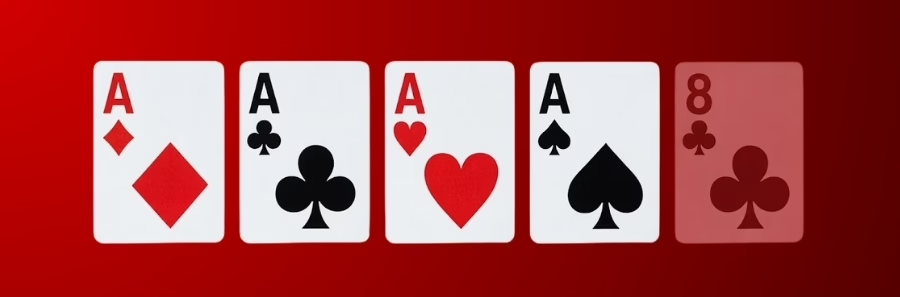
All four cards of one rank, plus any fifth card. Four sevens and a deuce. Players call it quads. In Hold’em, quads usually arrive in one of two ways: you hold a pocket pair and the board pairs that rank, or you hold one card of the rank and the board has delivered the other three. The second case is more common, and it is also more visible, because three of a kind on the board is hard to miss.
The higher rank wins. Four aces beat four kings. If both players have the same four of a kind — only possible when all four are on the board — the higher fifth card, the kicker, wins. If that card is also shared, the pot is split. A pocket pair does not help you once the board has already made quads for everyone. Your pair is not part of the five-card hand.
4. Full house
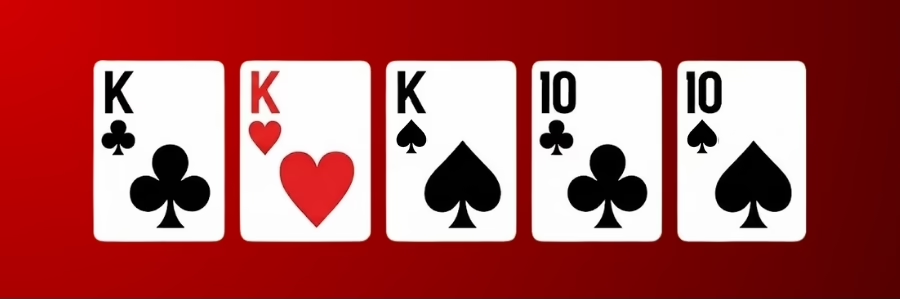
Three cards of one rank and two of another. Aces full of kings means three aces and two kings. Players shorten it to “aces full,” or simply “a boat.” It is the hand that punishes people who fall in love with two pair.
The three of a kind decides the tie first. Aces full of twos beats kings full of aces, because three aces outrank three kings. Only if the trips are equal does the pair break the tie. Kings full of queens beats kings full of jacks. Kickers do not exist on a full house. All five cards are already committed. That is worth saying twice at a table where someone insists their ace kicker should play.
5. Flush
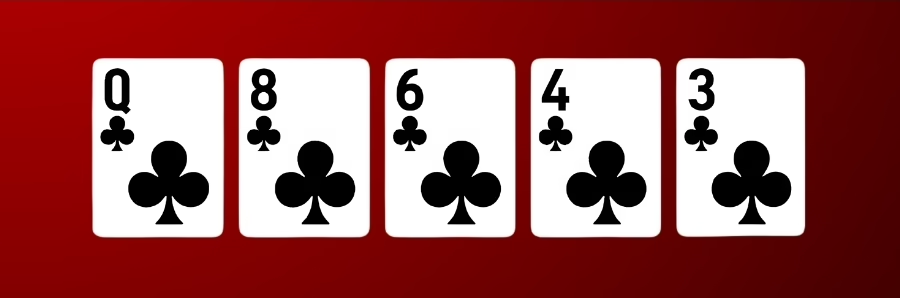
Five cards of one suit, not in sequence. If they are in sequence, the hand has already been promoted to a straight flush. An ace-high flush is the nuts on many boards. A queen-high flush is a strong hand that still loses to the king-high flush, and to the ace-high flush, without ceremony.
Compare the highest card, then the next, and so on down all five. An ace-king-high flush beats an ace-queen-high flush. If all five ranks match, the pot splits. The suit is irrelevant. Beginners mix this hand up with a straight more than any other pair of categories. A flush beats a straight. Always, in a standard deck. The memory hook is the rarity: there are fewer flushes than straights.
6. Straight

Five cards in sequence, not all of the same suit. The ace can sit on top, as in ace-king-queen-jack-ten, or on the bottom, as in ace-two-three-four-five. It cannot wrap around. King-ace-two-three-four is not a straight. It is ace-high with a disconnected mess underneath, and it loses to a pair of deuces.
The highest card in the sequence wins. A ten-high straight beats a nine-high straight. The wheel, ace through five, is the lowest straight and loses to every other straight. Broadway, ace through ten, is the highest. If both players hold the same straight, they split, even if one of them also holds a pair. The pair is not part of the five-card hand. On a board of jack-ten-nine-eight-two, a player with a queen and a player with a seven have the same straight. The queen does not play.
7. Three of a kind
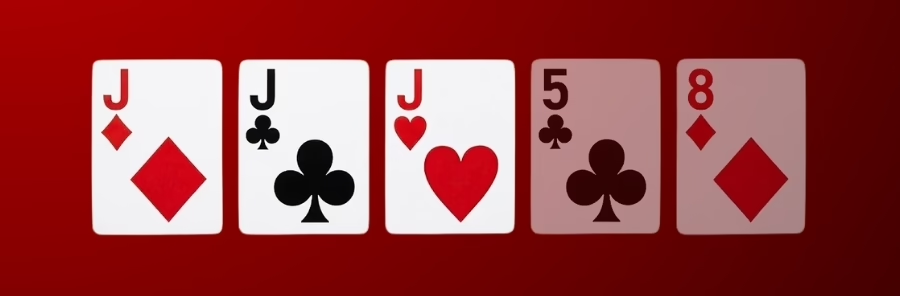
Three cards of one rank, with two unmatched side cards. In Hold’em, players distinguish a set from trips. A set is a pocket pair that meets one matching card on the board. Trips is one card in your hand matching a pair on the board. The ranking is identical. The distinction matters because a set is better hidden, and because the player with trips is more exposed to a full house if the board pairs. Three of a kind on the board, with neither player holding the fourth card, is sometimes called trips as well. Everyone is playing them, and the kickers decide it.
The rank of the three decides first. Three queens beat three jacks. Then the higher side card, then the second side card. Three nines with an ace and a four beats three nines with an ace and a three. Name both kickers. “I have trip nines” is not a complete hand.
8. Two pair
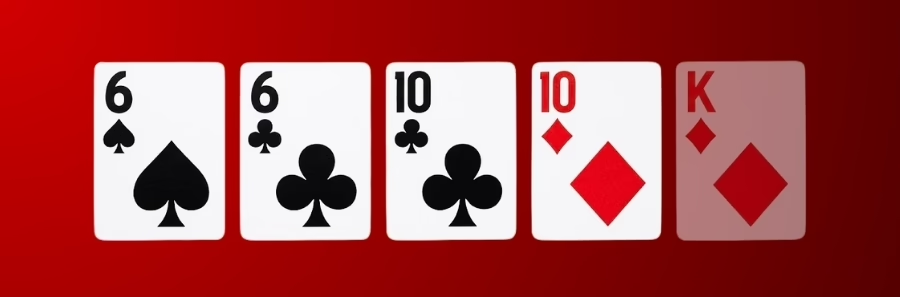
Two separate pairs, plus a fifth card. Aces and fives, with a king kicker. Compare the higher pair first, then the lower pair, then the kicker. Aces and deuces beat kings and queens. Aces and eights beat aces and sevens. If both pairs match, the kicker wins. If the kicker matches too, the pot is split.
This is where a lot of small pots are lost. A player with ace-king on a board of ace-seven-seven-four-two has two pair, aces and sevens, with a king kicker. A player with ace-four has the same two pair and a worse kicker, and loses. And, a player with pocket fours has two pair, aces and fours, and also loses to aces and sevens. The higher pair is what counts, and the board’s pair is shared. Pocket fours did not “counterfeit” in a mystical sense. They simply made the lower of the two pairs.
9. One pair
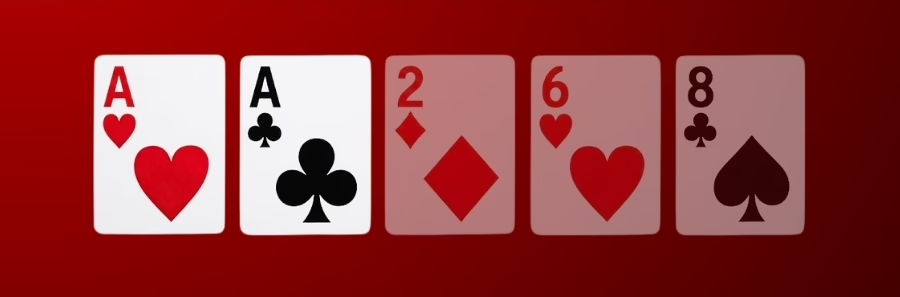
Two cards of one rank, plus three side cards. The pair rank comes first. Then the kickers, in order. Pair of tens with ace-king-queen beats pair of tens with ace-king-jack. Pair of nines does not beat pair of eights if the board has already paired higher and both players are playing that pair. Read the five cards, not the two in your hand.
One pair is the most common made hand at showdown in Hold’em. A large share of winning hands are simply the higher pair, or the same pair with a better kicker. Top pair with a weak kicker is still one pair. It beats ace-high. It loses to any better category, and it loses to the same pair with a better side card. That last loss is the one players describe badly. They say they got unlucky. Often they got out-kicked.
10. High card

No pair, no straight, no flush. The hand is its five highest cards, compared one by one. Ace-king-queen-nine-four beats ace-king-queen-nine-three. Players call the ace-high version “ace high” and rarely show it down with pride, but it wins plenty of pots when everyone misses. In a heads-up pot where both players checked the river, ace-high is a respectable winner. In a pot where someone has been betting, it is usually a bluff-catcher that failed.
Five cards still count. Ace-king does not beat ace-queen if the board has supplied the same three side cards and the queen player’s queen outranks the king player’s next card. Compare down the line until a card differs.
The list at a glance
Same order, with the comparison that breaks a tie. Suits are decoration in every row.
| Rank | Hand | Example | What breaks a tie |
|---|---|---|---|
| 1 | Royal flush | A-K-Q-J-10, same suit | No tie is possible. Split the pot. |
| 2 | Straight flush | 9-8-7-6-5, same suit | Highest top card. The wheel is lowest. |
| 3 | Four of a kind | K-K-K-K-4 | Higher quads, then the kicker. |
| 4 | Full house | Q-Q-Q-7-7 | Higher three of a kind, then the pair. |
| 5 | Flush | A-J-8-5-2, same suit | Highest card, then the next, all five. |
| 6 | Straight | 10-9-8-7-6 | Highest top card. Ace-to-five is lowest. |
| 7 | Three of a kind | 8-8-8-A-3 | Higher trips, then each kicker. |
| 8 | Two pair | A-A-5-5-K | Higher pair, then lower pair, then kicker. |
| 9 | One pair | J-J-A-9-4 | Higher pair, then kickers in order. |
| 10 | High card | A-Q-10-7-3 | Cards in order, from the top down. |
Hold’em rules the list leaves out
The ranking is a five-card ranking. Hold’em deals seven cards to each player if you count the board. You do not get to use six.
A flush and a pair is still a flush. The pair is decoration unless it improves the five. Players say “I have a flush and a pair” as if the pair were a bonus. It is not. It is a card that did not make the hand.
Both players can play the board.
If the five community cards are a straight, and neither player can make a better hand, they split. A pair in your hand does not beat a straight on the board. Your cards have to be part of a better five.
This is the rule behind the phrase “playing the board.” It feels unfair the first time it happens. It is the rule working as written.
The nuts depends on the board
The nuts is the best possible hand given the board, not the best hand in poker.
On a board of king-nine-eight-three-two with three hearts, the nut flush is the ace of hearts. Knowing the ranking is not the same as knowing whether you hold the best hand available.
A queen-high flush is a strong hand and still loses to the king-high flush. “I have a flush” is a category. “I have the nut flush” is a claim about the board. They are different sentences.
Kickers can decide the pot
Kickers are part of the hand. “I have a pair of aces” is incomplete when the board is ace-jack-six-four-two and your opponent also has an ace.
The second, third, and fourth cards decide it. Announce the five cards, at least to yourself, before you call a big river bet. A surprising number of calls look reasonable until the kicker is named out loud.
How ties are broken
Same category is not a split until every comparison fails. Work down this list and stop at the first difference.
| Hand category | Tiebreaker |
| Royal flush | Always splits. No card can be higher, and suits do not count. |
| Straight flush | Highest top card. Ace-high has already left this category and become a royal. The wheel is the lowest straight flush. |
| Four of a kind | Higher quads, then higher kicker. |
| Full house | Higher three of a kind, then higher pair. There is no fifth-card kicker. |
| Flush | Compare all five cards, highest to lowest. |
| Straight | Highest top card, with the wheel lowest and no kicker. |
| Three of a kind | Higher trips, then higher kicker, then second kicker. |
| Two pair | Higher pair, then lower pair, then kicker. |
| One pair | Higher pair, then kickers in order. |
| High card | Five cards, top down. |
If the comparison survives all five cards, the pot is chopped. Side pots do not change the ranking. They only change who is eligible to win which chips.
A player who is all-in can split the main pot and still lose a side pot to a better hand that was built with chips they did not have in front of them. The hands are ranked the same way in both pots.
What changes in other games
Omaha High
Omaha high uses the same order, with a construction rule that traps newcomers. You must use exactly two hole cards and exactly three board cards.
- Four hearts on the board and two hearts in your hand is not a flush. You would be using four board cards.
- Two pair on the board does not give you two pair unless you can build a legal five with two from your hand.
A common losing speech in Omaha starts with “but I had a flush.” The flush was not a legal hand.
Seven-Card Stud
Seven-card stud uses the same order. You make the best five of your seven private cards. There is no shared board, so “playing the board” does not arise. Kickers still matter, and a split is still a split.
Short-Deck Poker
Short-deck poker, also called six-plus, removes the twos, threes, fours, and fives.
The key ranking change: a flush beats a full house.
A flush becomes rarer than a full house, so the ranking flips. A straight can also be formed with ace-six-seven-eight-nine, because the low cards are gone.
Do not bring the standard list to a short-deck table without checking the house rule. The rest of the order is familiar. The one swap is expensive if you forget it.
Hi-Lo Games
Hi-lo games, including Omaha hi-lo and seven-card stud hi-lo, still use this list for the high half of the pot.
The low half uses a separate ranking, usually ace-to-five with eight or better required to qualify, and the lowest qualifying hand wins that half. A steel wheel, the ace-to-five straight flush, can scoop both. That is a feature of the split-pot structure, not a change to the high ranking.
Razz and 2-7 Lowball
Razz and 2-7 lowball reverse the idea. The worst high hand wins, under their own rules about whether straights and flushes count against you.
Those games are not played on this list. If someone tells you ace-five is the nuts, ask which game you are in before you agree.
How often each hand appears
In a random five-card hand from a 52-card deck, the counts are exact. Straight flushes in this table exclude royals. Flushes exclude straight flushes. Straights exclude straight flushes.
The totals add up to 2,598,960, which is every five-card hand.
| Hand | Five-card hands | Rough odds |
|---|---|---|
| Royal flush | 4 | 1 in 649,740 |
| Straight flush | 36 | 1 in 72,193 |
| Four of a kind | 624 | 1 in 4,165 |
| Full house | 3,744 | 1 in 694 |
| Flush | 5,108 | 1 in 509 |
| Straight | 10,200 | 1 in 255 |
| Three of a kind | 54,912 | 1 in 47 |
| Two pair | 123,552 | 1 in 21 |
| One pair | 1,098,240 | 1 in 2.4 |
| High card | 1,302,540 | 1 in 2 |
What About Texas Hold’em?
Hold’em showdowns are more generous, because each player picks the best five of seven. A pair shows up often. A full house is no longer a once-a-year event.
Rough figures used for seven-card Hold’em hands put the following categories at these rates:
| Hand category | Approximate frequency |
| One pair | 44% |
| Two pair | 23% |
| High card | 17% |
| Three of a kind | Around 5% |
| Straight | Around 5% |
| Flush | Around 3% |
| Full house | Around 2.6% |
| Four of a kind | Well under 1% |
A royal flush remains a story you tell later.
The practical point is relative strength, not the poster on the card-room wall. Top pair is often good on the flop and often not good by the river if the board has straightened or flushed.
Two pair is a real hand. It is also the hand that pays off a set, because the ranking puts three of a kind above two pair and the set is harder to see.
The ranking tells you what beats what. The board tells you how many of those better hands are available. Both facts belong in the decision.
Mistakes that cost the pot
Use this as a quick checklist when reviewing a hand.
- Treating a straight as stronger than a flush
- It is not. Flush sits above straight in every standard rule set. If a home game has reversed them, that is a house rule, and it should be said out loud before the cards come out.
- Wrapping the ace
- King-ace-two-three-four is nothing. The ace is high or low, not a hinge in the middle. The same mistake shows up one step down: queen-ace-two-three-four is also nothing.
- Counting six cards
- A straight and a pair is a straight. A flush and a pair is a flush. Say the five cards out loud if you are unsure which category you actually hold. The extra card can matter as a kicker only inside a category that still has room for one.
- Ignoring the kicker
- Same pair, worse side cards, lost pot. This is the most expensive beginner error that does not involve a misread category. It shows up constantly on paired boards, where both players share one of the pairs and the second pair, or the kicker, does all the work.
- Assuming your hole cards play
- If the board already has a straight or a flush, your pair has to improve on that five, not sit beside it. “I have aces” is not a rebuttal to a board straight.
- Forgetting the short-deck flip
- Flush over full house is the common rule in six-plus, and it is the rule at that table. Confirm before you sit, not after you call.
- Inventing a suit rank
- Spades do not beat hearts. If the room is playing that way, it is a home game, and you should hear the rule before the first hand. In a card room, equal ranks split.
- Calling a set and trips the same thing, then misreading how hidden the hand is
- The rank is the same. The information is not. A set can stack two pair. Trips, with a pair already on the board, gets a lot more respect, and deserves it.
A simple way to remember the order
Learn the top half as a block. The bottom half is obvious once you play a few sessions.
Royal flush → Straight flush → Four of a kind → Full house → Flush → Straight → Three of a kind → Two pair → One pair → High card
The top of the list is the part worth drilling.
- Flush beats straight.
- Full house beats flush.
- Four of a kind beats a full house.
- Straight flush beats four of a kind.
- Royal flush is the straight flush with an ace on top.
Everything below a straight is a pair structure: three of a kind, then two pair, then one pair, then nothing. If you can say that paragraph without looking, you know the ranking.
Practice the ranking
Deal five cards face up and name the hand before you look at a chart. Then name the five cards that make it, including the kicker.
Ten minutes of that is worth more than rereading the list. Do it again with two hands side by side and say which one wins, and why. The second exercise is the one that catches kicker mistakes.
What the ranking does not tell you
The list settles the showdown. It does not settle the hand. A worse hand can win if the better hand folds, and a better hand can lose money if it calls a bet it should not.
Rankings are the scoring system. Betting is the game.
Still, none of the betting makes sense until the scoring is automatic. You should be able to look at two hands and decide which five cards win, why, and whether a kicker is even in play.
Players must know when the board has already made the hand for both sides. Understanding that a flush beats a straight, that the wheel is the low straight, and that suits never break a tie remains essential.
That is the whole of poker hand rankings. Ten categories, a fixed order, and a short set of tiebreakers. The rest is what you do before the cards are turned over.


