Who Goes First in a Poker Game

The question usually means one of two things. Who has to act first on this betting round? Or who deals the first hand when a game is just sitting down?
Both have answers. Neither depends on who is ready, who won the last pot, or who has been waiting the longest to play a hand.
In Texas Hold’em and Omaha, the player to the left of the big blind acts first before the flop. After the flop, the first active player to the left of the button acts first.
In seven-card stud, the lowest upcard brings it in on third street, and the highest showing hand acts first after that. A home game that is just sitting down usually cuts for the deal, or draws for the button, and then the button moves clockwise.
That is the rule. The rest is what the rule is doing, and where a new player tends to miss it.
The short answer
- Hold’em and Omaha, before the flop: The player immediately left of the big blind acts first.
- After the flop: The first player still in the hand to the left of the button acts first.
- Heads-up: The button acts first before the flop and last on every later street.
- Seven-card stud: The lowest upcard brings it in on third street. The highest showing hand acts first on later streets.
- The button: Moves one seat clockwise after every hand.
The button is the whole system
Casinos do not let players deal. A house dealer handles the cards, burns, and mucks.
The white disc in front of one player, the dealer button, is a stand-in for the deal. It marks the seat that would have dealt if this were a kitchen table. Every betting order in a flop game is defined from that seat.
The button moves one position clockwise at the end of every hand.
- The player to the button’s left posts the small blind.
- The player to the small blind’s left posts the big blind.
- Everyone else waits.
Those two forced bets are already in the pot before anyone looks at a card. That is why the first real decision does not belong to the blinds.
Clockwise is not a style choice. It is the direction of the game in almost every card room in the world.
A player who wants to know who is next looks to the left of the last person to act, not to the right. A room that dealt the other way would not be playing a different strategy. It would be playing a different game, and no one would know whose turn it was.
Before the flop
Cards are dealt starting with the small blind and moving clockwise, one card at a time, until everyone has a starting hand.
- Texas Hold’em: Two starting cards.
- Omaha: Four starting cards.
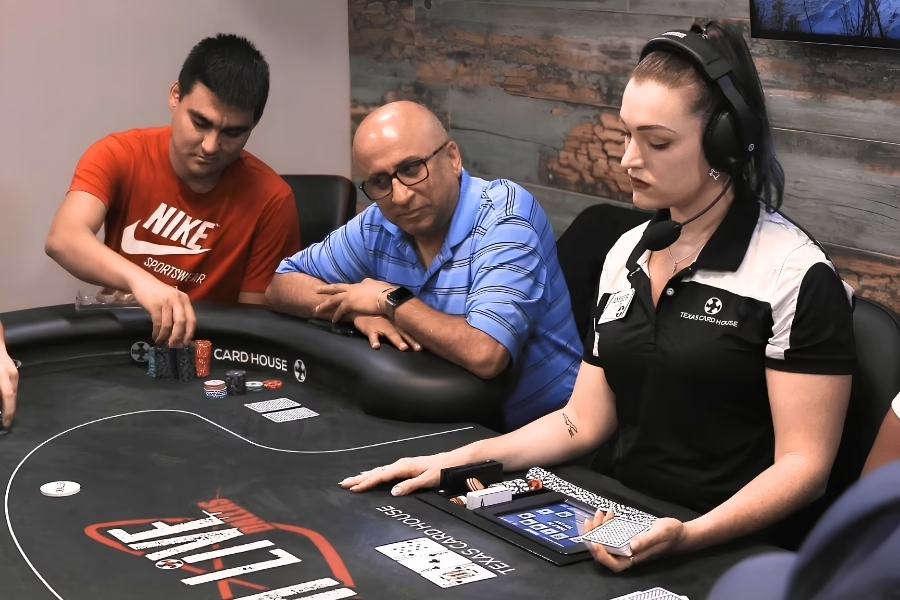
The deal order is not the betting order. The small blind sees a card first and still does not speak first.
Betting starts with the first player to the left of the big blind. At a nine-handed table that seat is called under the gun (UTG).
The name is old and accurate. There is a full table still to act, and no one has said a word. You speak into silence.
Under the gun can fold, call the big blind, or raise. If that player folds, the option passes left to the next live player, and so on around the table.
The button acts after the cutoff. The small blind acts after the button. The big blind acts last before the flop, but only if the action has not already ended.
If everyone folds to the big blind, there is no decision to make. The big blind wins the blinds and antes without showing a hand.
The big blind’s option
If one or more players call and nobody raises, the big blind has an option.
The big blind may check and see a flop for the amount already posted, or raise. That option is the reason the big blind is last to act before the flop. The forced bet bought the right to close the action.
What happens after a raise?
A raise reopens the round. Anyone who has already acted may fold, call the extra, or raise again, until the bet is matched by every player who wants to stay in.
The round ends when the last raise has been called, or when everyone else folds.
First to act does not mean first and done. It means first, and then possibly again, once someone behind has raised.
After the flop
The flop is three community cards, dealt after a burn card.
From this street on, the blinds are no longer last. The first active player to the left of the button opens the betting.
Who that is depends on who is still in the hand:
- If the small blind is still in, the small blind acts first.
- If the small blind folded before the flop, the big blind acts first.
- If both blinds folded, the next active player clockwise who saw the flop acts first.
That player may check or bet. A check passes the option without putting money in. A bet forces the next player to fold, call, or raise.
Action continues clockwise. The button, if still in, acts last.
Last to act is the best seat in poker, because every other player has already shown something: a check, a bet, a call, or a fold.
The turn and the river work the same way. A new card does not reset the button or move the blinds.
The first live player left of the button starts. The button finishes. Only the end of the hand moves the disc, and it moves whether the hand ended on the flop or went to showdown.
Who gets skipped?
A player who folded before the flop is skipped for the rest of the hand. An empty chair is skipped.
A player who is all-in and has no decision left is skipped for betting, though that player still has a hand if the pot reaches showdown.
Action is an order of people who can still act, not a roll call of every seat.
Heads-up is the exception people miss
Two players change the map. The button posts the small blind. The other player posts the big blind.
There is no under the gun, no cutoff, and no seat that is out of the blinds.
| Betting round | Who acts first? |
|---|---|
| Before the flop | The button, who also posts the small blind |
| Flop, turn, and river | The big blind |
Players who learned the game nine-handed often get this wrong for a hand or two. They wait for the big blind to act before the flop, because they remember that the big blind is last.
Or they act first on the flop because they are in the small blind and remember that the small blind usually leads.
In heads-up, the button is the small blind. Those are not two seats. They are one seat with two jobs.
The same rule holds at the end of a tournament. When two players remain, the button posts the small blind, acts first preflop, and acts last on every later street.
A final table that just lost its third player has changed games, even if nobody announced it. The player who picks up the button in that spot should expect to act first on the next deal.
What the seats are called
Names are a map of the order. At a full Hold’em table they run like this, starting with the first to act before the flop.
| Position | Where it sits and when it acts |
|---|---|
| Under the gun (UTG) | First to act preflop |
| UTG+1 | The next seat to act |
| Middle position | Follows the early-position seats |
| Hijack | Two seats off the button |
| Cutoff | One seat off the button; acts immediately before it preflop |
| Button | Acts after the cutoff preflop; last after the flop |
| Small blind | Immediately left of the button; acts after the button preflop and first postflop if still in |
| Big blind | Immediately left of the small blind; last preflop and first postflop if still in |
Shorter tables drop the early names. Six-handed, the first seat is often charted as the hijack, because there is no full early-position problem left.
Three-handed, the button, the small blind, and the big blind are the whole table.
The labels change. The rule does not. Left of the big blind starts the hand. Left of the button starts every street after that.
Position names are strategy talk, not rules. A floor will never say that the hijack is out of turn. A floor will say that action is on the seat two to the right of the button.
Learning the names is useful. Learning to find the button is what keeps a player from speaking early.
Why the order is built this way
The blinds are a tax for sitting in those seats. They exist so the pot is not empty when the cards come out, and so a player cannot wait forever for a premium hand.
Because that money is already in, the game does not ask the blinds to act first. It asks the players who have put in nothing.
After the flop, the logic flips. The forced bets are done. What matters now is information. The player who acts last has seen the checks and the bets.
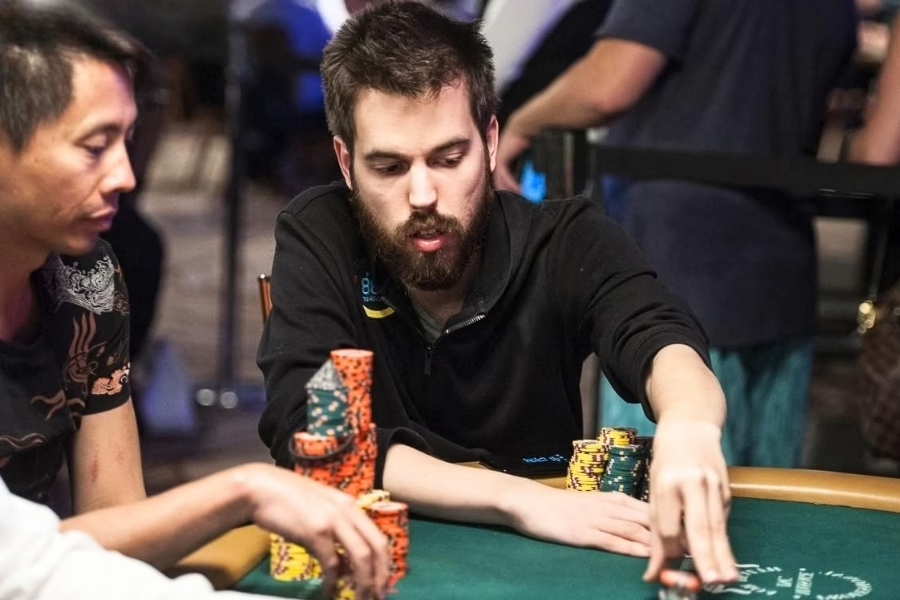
The player who acts first has seen nothing this street. Putting that burden on the blinds, who are already out of position for the rest of the hand, is how the button earns its reputation.
You pay the blinds once each orbit. You play the button once each orbit. In almost every serious game, the second of those is the profitable seat.
None of this changes between a one-two cash game and a tournament with antes. Antes raise the price of folding. They do not move the first speaker.
The player left of the big blind still starts the hand. The player left of the button still starts the flop.
Who acts first, by street
The same table covers the games a new player is likely to sit in. Flop games follow the button. Stud games follow the open cards.
| Street | Who acts first |
|---|---|
| Before the flop (Hold’em, Omaha) | Player immediately left of the big blind |
| Flop, turn, and river | First active player left of the button |
| Heads-up, before the flop | The button, who also posts the small blind |
| Heads-up, after the flop | The big blind |
| Seven-card stud, third street | Lowest upcard, which must bring it in |
| Seven-card stud, later streets | Highest hand showing |
| Razz, third street | Highest upcard, which must bring it in |
| Razz, later streets | Lowest hand showing |
Stud does not use a button for order
Seven-card stud, razz, and stud eight-or-better do not post blinds in the standard structure. Each player posts an ante. Then each player receives two downcards and one upcard.
The upcard is the door card. A button may still mark the dealer, so the room knows who deals and who receives cards first, but it does not pick the first bettor.
Third street
On third street, the lowest door card must bring it in. That is a forced bet, smaller than a full bet, and it is the first action of the hand.
In razz, which plays low, the highest door card brings it in, because high is the worst starting show.
A player who is brought in may complete to a full bet instead of posting only the bring-in. Completing is a choice. Bringing it in is not.
Later streets
On later streets, the highest board acts first in high stud. That player may check or bet. In razz, the lowest board acts first.
If two boards tie, the bring-in or the first action usually falls to the player closest to the dealer’s left, the one who would be first in the ordinary rotation. House rules spell out the tie.
The point is the same either way. The open cards decide the order, because there is no button doing that job.
A player who sits down at a stud table and waits for the seat left of the button to start the betting will wait through the hand. Look at the door cards. The worst of them, for the game being played, has to speak.
Draw poker and games without a standard
Five-card draw is the old home-game game, and it does not have one worldwide order the way casino Hold’em does.
With an ante and no blinds, the player to the left of the dealer acts first, before the draw and after it. That seat is sometimes called the age, or the eldest hand.
With blinds, many home games borrow the Hold’em order: left of the big blind first, button last after the draw.
The sheet on the table, or the host, decides. Ask before the first hand if the game is not one you already know.
A draw game that looks like Hold’em is not always using Hold’em’s order, and a draw game that looks old-fashioned may have picked up blinds last year without telling the rulebook.
Who deals the first hand
“Who goes first” is sometimes a question about the opening deal, not the opening bet.
In a card room the house decides. A new table gets a button. The floor or the dealer places it, often after a high-card draw so nobody can claim the seat was assigned by favor.

The player who draws the highest card gets the button. In some rooms the button is placed by the house and the game simply starts. Procedures differ.
The effect is the same. One seat is marked, the blinds are posted to its left, and the game has a direction.
At home
The usual methods are a cut for the deal, a draw for high card, or the host dealing the first hand and then passing the deal clockwise.
If players deal their own cards, the dealer is the button. If one person deals all night, a button still has to move, or the same two players will post every blind.
The button should move after every hand, including a hand that ends before the flop. A missed move is a misdeal of the next hand’s positions.
Correct it before cards are dealt, not after someone has looked. A player who notices the button did not move should say so while the cards are still face down.
Straddles, missed blinds, and skipped seats
Straddles
A straddle is a voluntary blind, usually posted by under the gun for twice the big blind. In most card rooms a live straddle buys the big blind’s privilege.
Action starts to the left of the straddler, and the straddler acts last before the flop. The straddle did not invent a new order. It inserted one more forced bet and moved the first speaker one seat left.
A button straddle, sometimes called a Mississippi straddle, is allowed in some rooms and not in others.
Where it is allowed, the button usually acts last before the flop, and the first speaker is defined by the house, often the small blind or the seat that would have been under the gun.
Read the posted rule. A straddle is a local custom sitting on top of the standard order, not a replacement for it.
Missed blinds and skipped seats
A player who misses a blind and returns to the table posts the amount owed or waits for the big blind, under the rules of that game. Until that player is dealt in, the seat is skipped.
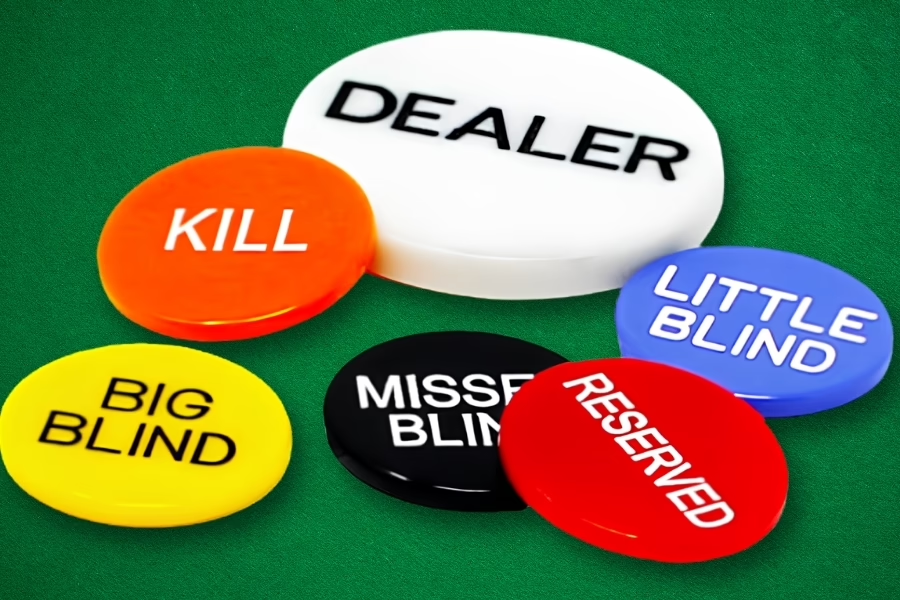
Action moves to the next live player. An empty chair does not get a turn, and a player sitting out does not get one either.
The order closes up around the absence.
Acting out of turn
Acting out of turn is a floor decision in a card room and a mess at home.
The common rule is that an out-of-turn check or fold is binding if the action does not change before it reaches that player. A bet or a raise in between can void it, and the player then acts again in turn.
Rooms differ on an out-of-turn raise. Some bind it. Some pull it back. The card room’s rule sheet is the authority, not the player who spoke early.
Even when the action is pulled back, the damage is done. The table heard a check, a fold, or a raise that was not supposed to exist yet. Players behind will use it.
Wait.
If you are not sure it is your turn, look for the button, then look left.
- Before the flop: Count from the big blind.
- After the flop: Count from the button.
- In stud: Look at the door cards.
Those three checks cover almost every hand a new player will sit in.
Why the first player is in trouble
First to act is not a penalty in the rulebook. It is a penalty in the math.
The player under the gun has the most opponents left to act and the least information. A raise from that seat gets called by hands that can stand the pressure, and it gets reraised by hands that were waiting for someone else to build the pot.
Strong players open fewer hands from early position than from the cutoff or the button. The cards did not change. The number of people still to speak did.
The small blind has a related problem after the flop. That seat acts first on every later street and has already put money in.
Calling a raise from the small blind, then leading into the field on the flop, is how a lot of chips move to the button. Checking is available. It is often correct.
First to act does not mean first to bet.
Last to act has the mirror image. The button can see a check from the blinds and bet, or see a bet and fold without having put in a chip past the preflop call.
Position is the right to decide with more of the story already told. The button is that right, once per orbit, which is why players fight for it and why a missed button is worth stopping the game to fix.
A one-hand summary
- Deal, or place the button.
- Post the small blind to its left and the big blind to the left of that.
- In Hold’em and Omaha, the next player starts the betting.
- After the flop, start again from the button’s left.
- In stud, let the door cards pick the first player.
- Move the button clockwise when the hand is over.
Do that, and the question is settled before anyone has to ask it.
The player who still is not sure can look at the disc. Left of the big blind before the flop. Left of the button after it. Worst door card in stud.
Everything else is a house rule sitting on top of those three.


