What is a Slow-Roll in Poker
The cards are about to come out, or they already have. You hold the nuts. The other player is all-in, or the betting is finished, and nothing you do in the next ten seconds can change the size of the pot.
A normal player calls, tables the hand, and lets the dealer push the chips. A slow roller waits.
That wait is the whole offense. A slow roll is a deliberate delay of a call or a reveal when the player already knows they have won, and when waiting cannot change the result. It happens after the betting is done, or when a call closes the action. The point is not to win more money. The point is to let the other person hope.
A slow roll is stalling on purpose with a hand you already know is best, once a call or a showdown reveal cannot change the pot.
What it looks like at the table
The pattern is simple once you have seen it. Someone who should already know the answer behaves as if the answer is hard.
The cleanest version is the all-in call. An opponent moves in. You look down at pocket aces, or at the stone nuts on the river, and you are the only player left to act. A call ends the hand. There is no raise left to induce, and no player behind you to fold out. You still sit in the chair, check the board again, and let the other person sweat a decision you made the moment the cards hit the felt.
The showdown version is meaner, because the other player can see the hope. Betting is over. It is your turn to show, or you have already called and the cards are still face down. You wait. They table two pair. They reach for the pot. Then you turn over the flush.
Some players add a line on the way: “I thought you had me.”
They did not think that.
A third version is verbal. You under-declare the hand. “Pair of deuces,” you say, and only after the other player relaxes do you add the queens that make the full house. Or you lift the cards toward the muck, stop, and table the winner.
The motion is the insult. It tells the table you were willing to let someone celebrate a pot they had already lost.
None of these plays wins an extra chip.
- If the delay can still change how much money goes into the middle, it is probably something else.
- If the delay can only change how the other person feels, it is a slow roll.
Four ways it usually happens
| Form | What the player does |
|---|---|
| Open call with the nuts | An opponent is all-in. You are the only player left, and a call ends the hand. You already know you are calling. You sit on it. |
| Showdown stall | Betting is over. You have the winner, but you wait for the other player to table, celebrate, or reach for the pot, then flip your cards. |
| Under-declaration | You announce a worse hand than the one you hold — “pair of deuces” — and only later add the queens that make the full house. |
| Fake muck | You lift the cards as if you are folding them, then table the winner once the other player thinks the pot is theirs. |
Slow roll, slow play, and Hollywood
Players mix these up, and the mix-up causes half the arguments.
Slow playing is a strategy. Hollywood is an act. A slow roll is a jab after the hand is over.
Slow Play
Slow playing means you have a strong hand and you bet small, or you check, because you want the other player to put money in for you.
You are trapping. The pot can still grow.
- A check-raise with a set is not a slow roll.
- A flat call with aces, planning to raise a squeeze behind you, is not a slow roll.
That is legal, ordinary poker.
Hollywood
Hollywood is the performance while money is still in play. You stare at the board, count your chips, and sigh, then raise.
You want the other player to misread the strength of your hand and make a worse decision.
Plenty of regulars find it annoying. It is still part of live poker, because the act can change the action.
The line is the betting. If a decision remains, the pause can be a play. If no decision remains, the pause is for the audience.
The honest delay
There is also the honest delay. A player tables a hand, stares at the board, and needs a second to see that their two pair lost to a flush.
That looks like a slow roll from across the table. It is not one.
Intent is the difference.
- A new player who has not read the board is making a timing mistake.
- A player who announces “nice hand,” waits, and then shows the nuts is not.
One gray spot is worth naming. If an opponent has committed almost their entire stack and a few chips remain behind, a long tank with the nuts before you put them in can feel like a slow roll even though a tiny bet is still available. The pot will barely change. Most players treat that pause as the same offense.
A genuine close decision — a bluff-catcher, a chopped board, a hand you have not fully read — is not in that category.
Same pause, different meaning
| Name | When | What it can change | How the room treats it |
|---|---|---|---|
| Slow roll | After the result is fixed | None. The pot size will not change. | Poor etiquette. Widely disliked. |
| Slow play | During the hand, while bets remain | Induce a bluff or a thin call. | Standard strategy. |
| Hollywood | During the hand, while bets remain | Disguise strength and shape the next decision. | Accepted, if sometimes theatrical. |
| Real tank | A close decision, or a hand you have not read | Get the decision right. | Normal. Intent is the difference. |
Why players take it personally
Poker already hands out bad beats. You can play a hand well and lose it to a two-outer. Most regulars can live with that.
A slow roll adds a social insult to the loss.
The victim thought, for a few seconds, that they might have won. The slow roller knew they had not. That gap is the cruelty.
It also wastes the table:
- A cash game is a queue for the next hand.
- A tournament table is on a clock.
- A bubble or a pay jump makes every minute feel expensive.
Dragging out a result that was already known is a tax on everyone else in the game, not only on the person who lost the pot.
The usual defense is that it is a tilt weapon. Make someone angry and they will play the next orbit badly. That can be true for a hand or two.
It is a bad trade.
The person you tilted will remember you. So will the rest of the table. In a game where you need action, a reputation for rubbing it in is expensive.
Players may:
- tighten up against you
- talk about you on break
- stop giving you the casual calls that pay the bills
There is a status piece to it as well. Slow rolling is a way of saying the other person’s result was never in doubt, and that you had the spare time to watch them find out.
In a home game that can end the night. In a card room it can end in a floor call, even when no rule was technically broken.
Is a Slow Roll against the rules?
Usually it is etiquette, not a penalty, and that is why it survives.
There is no universal poker rule that says “do not slow roll,” because the thing being banned is intent, and intent is hard to prove. A player can always claim they were reading the board, protecting a hand, or thinking about a call.
Floor staff still have tools. Tournament rules on pace of play, stalling, and unsportsmanlike conduct give a director room to act when the delay is obvious or repeated.
At the World Series of Poker, players can call the clock, and the floor can put a player on a short countdown if the decision is taking longer than the spot deserves.
A director who thinks someone is stalling the game can issue a penalty without having to use the words “slow roll.”
One theatrical pause is rarely enough. A pattern is different.
Verbal tricks sit closer to the rulebook. Misdeclaring a hand, splashing the pot, or reaching toward the muck and then tabling can cross into angle-shooting, which rooms do penalize.
The most problematic versions include:
- Misdeclaring a hand
- Announcing a worse hand to bait a reaction
- Reaching toward the muck and then tabling the winner
- Splashing the pot
Online, the time bank does a lot of the work. Sites give you seconds. Using them is within the software. A site will rarely punish a slow call unless the chat becomes abuse.
The software cannot see intent. The chat can.
Clips that stuck
A few televised hands did more than any rule to fix the word in people’s heads.
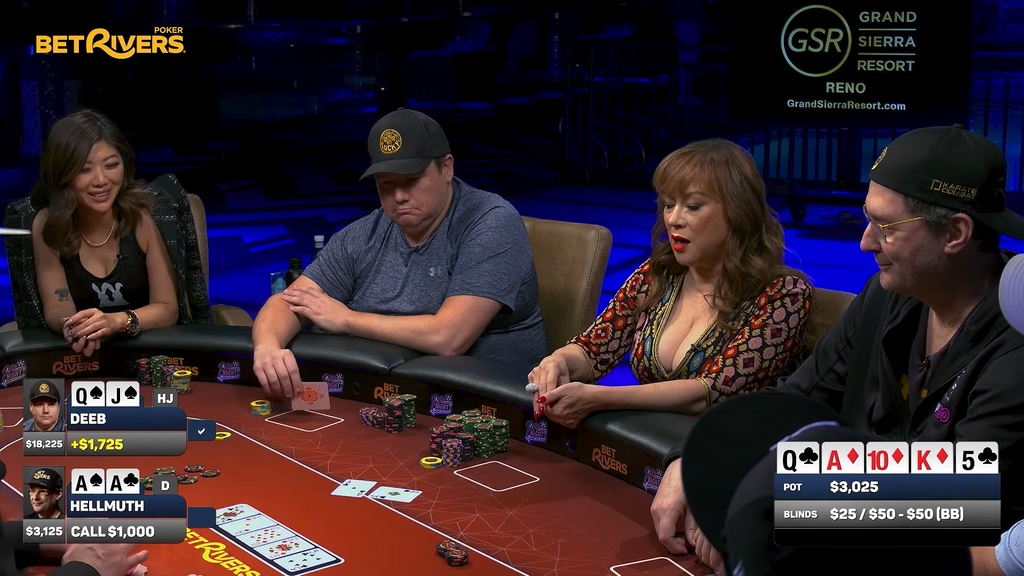
Shaun Deeb and Mike Matusow
On a Poker Night in America broadcast, Shaun Deeb and Mike Matusow played a hand that became a reference clip.
Deeb, with the winner, took an extended pause before showing. Matusow, who has never been shy about a reaction, went into a tirade that traveled farther than the hand.
The pause did what a slow roll is built to do. It produced a scene.
It also followed both players, which is the usual price.
Will Kassouf at the 2016 WSOP
Will Kassouf’s run in the 2016 World Series of Poker Main Event is the other clip people reach for.
Against Stacy Matuson, Kassouf held the nuts and spent a long time in speech play before he called. The floor had already been involved with his pace and his talk in that tournament.
Players treated the hand as the line between gamesmanship and rubbing a result in. Kassouf has drawn penalties in later years for conduct and pace. The 2016 hand is still the one attached to his name.
Dylan Gang and Garrett Adelstein
A quieter version showed up on Hustler Casino Live, when Dylan Gang slow rolled Garrett Adelstein.
Adelstein’s public response was the notable part. He stayed level and later said the pause had not gotten to him.
That is the counter the old regulars recommend, and it is harder than it looks.
The slow roll wants a reaction. A flat face denies it.
These are not court cases. They are hands a lot of players have watched, argued about, and used as a standard.
The details of the speech differ by retelling. The shape does not: a result that was already known, a delay that did not change it, and a room that noticed.
Live rooms and online tables
| Live | Online | |
|---|---|---|
| What happens | A slow roll is visible through the reach for the pot, the half-smile, or the cards staying face down while the dealer waits. | The same act becomes a timer, with the player letting the time bank run before calling or revealing. |
| Who notices | Other players, the dealer, and even a floor person walking past can see it. | Intent is harder to prove, and the other player cannot see your face. |
| Social impact | Social cost is immediate, which is why serious cash-game lineups police it harder than a casual home game. If you can choose your table, you do not have to sit with it. | Chat does the work the table would have done. Streamers who build a brand on it find out quickly that poker audiences have a long memory for this one and a short memory for the joke. |
Tournaments sit between the two. Cameras reward a reaction, and a delayed call with the nuts is an easy clip. The same tournament has a clock, a floor, and a rule against stalling.
A one-time pause may pass. A player who does it every time they have the nuts will eventually meet a director who treats it as pace of play.
How not to Slow-Roll
The habit is easy to avoid if you decide the rule before you sit down.
Call and table
If a call ends the hand and you already know you are calling, call. Turn the cards over when it is your turn to show. Do not wait to see whether they have the hand you already beat.
Read the board before you speak
Most accidental slow rolls are misreads. Check your hand, then talk.
“I have a pair” is fine if that is all you have. It is not fine as a setup for the full house.
Do not fake a fold
Lifting cards toward the muck and then tabling them is the version other players remember.
- If you are showing, show.
- If you are folding, release the cards.
- Say so when you are actually unsure.
“I think you have me” is ordinary poker if you mean it. The offense is saying it when you know you do not.
If you want to disguise a hand, do it while there is still a bet to win.
That is the game. Once the bet is gone, the disguise has nothing left to do.
If you are Slow Rolled
The next minute matters more than the pause.
A visible blow-up is the result the other player was shopping for. A calm nod, and the next hand dealt, costs them the only thing they were trying to buy.
- Call the clock if the delay is long.
- Mention a pattern if the same player does it all night.
- Do not expect a penalty for a single sour pause.
- Do not provide the speech that turns the hand into their clip.
Keep the information. A player who slow rolls is telling you they care about the reaction. That is useful. They may overplay a later hand to get another scene, or they may shut down once they see you will not give them one. Either read is more valuable than a speech.
Then let it go.
The pot is the same size it was going to be. The bad beat, if there was one, already happened. The slow roll only added a few seconds of theater.
You do not have to applaud.
The short version
A slow roll is a delay after the result is known. It is not a trap, nor is it a tough decision played slowly.
There is no money to be won from it.
It spends the table’s time to make one person feel the loss twice.
- Call when you are calling.
- Show when you have won.
- Save the acting for the streets where a chip is still in play.
The rest of the table can tell the difference, and they keep score.


