What Is a Hero Call in Poker?

A hero call is a call made with a relatively weak or marginal hand—usually on the river—because you believe your opponent is bluffing often enough to make the call profitable.
Your hand typically beats most of their bluffs but loses to most of their value hands. The “hero” label comes from how difficult and dramatic these decisions feel at the table.
Hero calls are a specialized form of bluff-catching. Not every bluff-catch earns the name; the term is usually reserved for the tougher, higher-variance spots where the absolute strength of your hand looks thin and the bet is large or scary.
Hero Call vs. Ordinary Bluff-Catch
A standard bluff-catch is any call where your hand beats the opponent’s bluffs but loses to their value range. It is a core part of balanced strategy in modern poker.
A hero call is the subset of those decisions that look especially brave:
- You hold a weak-looking hand (second pair, third pair, ace-high, or even king-high).
- The bet is large relative to the pot.
- Something about the line, sizing, or your read suggests the opponent’s range is weighted more toward bluffs than it first appears.
Every hero call is a bluff-catch, but not every bluff-catch is dramatic enough to be called heroic.
The math is the same; the optics are different.
The Math Behind a Hero Call
Because a pure bluff-catcher has 100% equity against bluffs and 0% equity against value hands, the decision reduces to a simple comparison:
Required bluff frequency = amount to call ÷ (pot + amount to call)
Common examples:
| Bet size | Required win frequency |
|---|---|
| Half-pot bet | Roughly 25% |
| Pot-sized bet | Roughly 33% |
| 1.5× pot overbet | Roughly 38% |
| 2× pot overbet | Roughly 40% |
If you estimate that the opponent is bluffing more often than the required percentage, the call is profitable in the long run—even if you lose this particular hand.
If they are bluffing less often, folding is correct.
This is pure expected-value thinking. Results on any single hand do not change the math.
Over thousands of similar spots, the player who correctly estimates bluff frequencies will win.
The key is not whether your hand looks strong. It is whether your opponent bluffs often enough to make calling profitable.
Key Factors That Make a Hero Call Reasonable
Opponent Tendencies
Hero calls are far more profitable against aggressive or creative players who bluff too often than against tight, passive opponents.
Against a player who almost never bluffs big, even a suspicious line is usually value.
Population tendencies also matter: most recreational players under-bluff large river bets, while many regulars and online players bluff closer to theoretically correct frequencies.
Line and Story
Ask whether the opponent’s betting pattern makes sense for the strong hands they are representing.
If their value range is capped or very narrow by earlier actions, a large river bet becomes more likely to be a bluff.
For example, a player who checked the flop and turn after calling a preflop raise has a harder time representing the nuts on the river than a player who bet all three streets.
Blockers
The best hero-call hands often block the opponent’s value combinations while unblocking their bluffs.
Holding a card that removes some of the nuts (or strong value hands) improves the ratio of bluffs in their range.
Conversely, holding a card that blocks their missed draws makes the call worse.
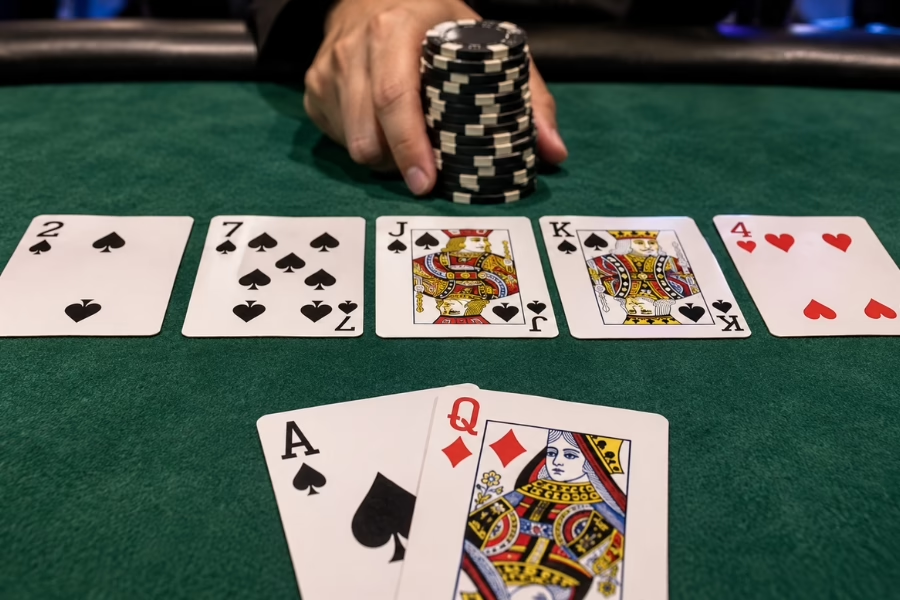
A classic example is holding the ace of the suit on a four-flush board.
That ace blocks the nut flush (a common value hand for large bets) while leaving many busted flush draws in the opponent’s range.
Bet Sizing
Large overbets are usually polarized (nuts or bluff). Small bets are more often thin value.
The sizing helps you estimate how many bluffs are required and whether the opponent’s range is likely to contain them.
Polarized sizings increase the number of bluffs you need to call profitably, but they also make the opponent’s range easier to read when you have good information.
Board Texture and Range Interaction
Some boards naturally create more bluffs.
Missed straight and flush draws on the river give aggressive players natural bluffing candidates.
Dry boards with few possible draws make large bets more likely to be value.
Clear Examples
Classic River Hero Call
The board is A♠ K♦ 8♣ 5♥ 2♠.
You hold Q♣ Q♦.
Your opponent overbets the river.
Your queens beat missed draws and pure air but lose to any ace, king, or better.
If the line and your read suggest they are bluffing more than the pot odds require (and your queens do not block their bluffs), calling is a hero call.
Blocker-Driven Hero Call
You hold the ace of the suit on a four-flush board.
Opponent fires a large river bet.
Your ace blocks the nut flush (a common value hand for that size) while leaving many busted draws in their range.
The combination of the blocker and the polarized sizing can justify calling with a relatively weak made hand such as second pair or ace-high.
Multi-Street Story Inconsistency
Opponent check-calls the flop, check-calls the turn, then overbets the river on a board that has not dramatically changed.
Their earlier passive line makes it harder for them to hold the strongest hands, increasing the relative number of bluffs in their river range.
When to Avoid Hero Calls
- Against passive or calling-station opponents who rarely bluff.
- When the opponent’s line is consistent with a wide value range.
- When your hand blocks their bluffs rather than their value hands.
- In multi-way pots (someone is more likely to have a real hand).
- When you are simply curious and have not checked the pot odds.
- When the population under-bluffs the specific spot (common on many big river bets).
Calling just to “see if they have it” is not a hero call—it is a guess, and guesses lose money over time.
Common Mistakes
- Hero-calling too often against the population (most players under-bluff big river bets).
- Focusing on the absolute strength of your hand instead of the opponent’s range composition.
- Ignoring blockers or using them in the wrong direction.
- Failing to calculate the required bluff frequency before deciding.
- Confusing a correct bluff-catch that lost with a bad decision (results are not the same as expected value).
- Overvaluing “reads” that are not based on clear patterns or population data.
Final Thoughts
A hero call is not an act of bravery for its own sake.
It is a calculated decision that your opponent’s range contains enough bluffs to clear the price you are being laid.
When the line is inconsistent with value, the sizing is polarized, your hand has useful blockers, and the opponent is capable of bluffing, the call can be a profitable long-term play.
When those factors are missing, the same call becomes an expensive way to satisfy curiosity.
Study the math, build accurate ranges, review your hand histories, and the heroic moments will take care of themselves.
The players who profit from hero calls are not the ones who make the flashiest calls—they are the ones who make the right ones at the right frequency.
Frequently Asked Questions
Is a hero call the same as bluff-catching?
A hero call is a type of bluff-catch. All hero calls are bluff-catches, but the term “hero call” usually describes the more difficult or dramatic versions of those decisions.
Can you hero-call on earlier streets?
The classic hero call occurs on the river. On earlier streets you usually have equity or the option to continue, so the pure “beats bluffs, loses to value” dynamic is less clear.
Calls with weak hands on the flop or turn are more often about implied odds or floating.
What is a hero fold?
The opposite play: folding a strong hand because you have a read that you are beaten. Like hero calls, hero folds are only correct when the read is reliable and the math supports the decision.
They are less common in modern theory because strong hands retain value against many ranges.
How do solvers treat hero calls?
Solvers rarely “hero call” in the dramatic sense. They call with the bottom of their range when the opponent’s bluff frequency exceeds the required threshold.
Human players label the same mathematical decisions “hero calls” when the hand feels weak and the bet looks scary.


