What Is a Donk Bet in Poker?

Use up and down arrow keys to resize the meta box pane.
A lead into the previous aggressor from out of position. Once dismissed as a weak play, now recognized as a useful tool on the right boards.
A donk bet is a wager made by a player who is out of position and who was not the aggressor on the previous betting round.
In the classic example, the big blind calls a button raise preflop, then leads out on the flop instead of checking to the raiser.
The term carries historical baggage. For years many players treated any donk bet as an automatic sign of inexperience.
Modern solver work has changed that view. On certain board textures the out-of-position caller’s range actually connects better than the raiser’s range, and leading becomes the higher-EV play.
The Short Definition
A donk bet occurs when the player who acts first on the current street (and who did not take the last aggressive action on the previous street) bets into the previous aggressor.
The most common form is a flop lead by a preflop caller into the preflop raiser.
The bet denies the raiser the chance to make a continuation bet.
Small sizing (roughly 25–40% of the pot) is typical when the play is used deliberately.
Where the Term Comes From
“Donk” is short for “donkey,” a long-standing poker insult for a weak or novice player.
Leading into the preflop raiser looked, to many observers, like something only a donkey would do. The standard advice was simple: check to the aggressor and let them decide whether to continue.
The label stuck even after the strategic picture grew more nuanced.
Today the word is used descriptively by most regulars; it no longer automatically implies that the bettor is playing poorly.
Still, the pejorative origin explains why many players remain skeptical of the line until they see the range analysis.
Clear Examples
Flop Donk Bet (Most Common)
Button raises to 2.5 big blinds. Big blind calls.
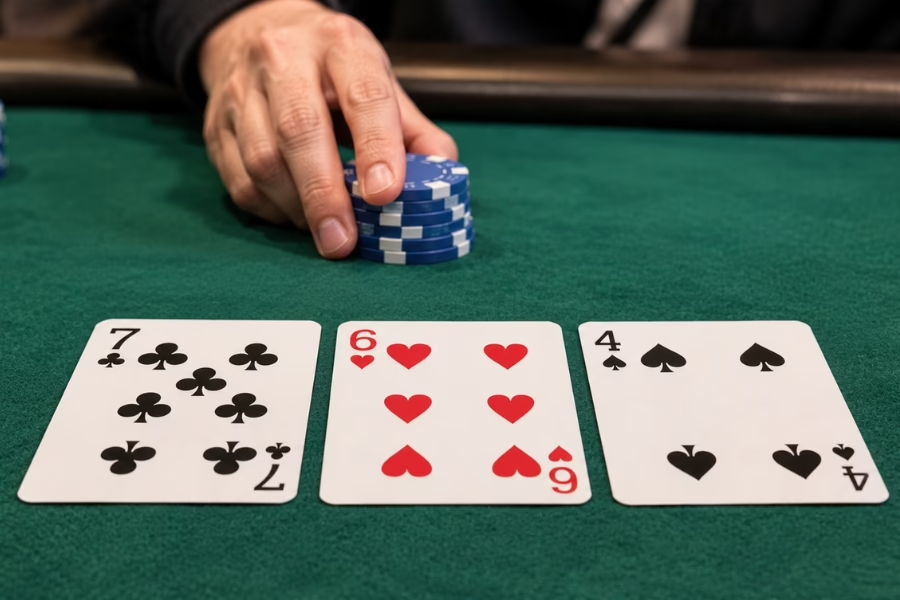
Flop comes 7♣ 6♥ 4♠.
Instead of checking, the big blind bets 2.5 big blinds into the 5.5 big-blind pot.
That is a donk bet. The big blind is out of position and is leading into the preflop raiser.
Turn Donk Bet
Same preflop action. Big blind checks the flop, button continuation-bets, big blind calls.
Turn is an offsuit 5. Big blind now leads.
This is also a donk bet because the button was the aggressor on the previous street.
Important clarifications: a lead in a limped pot is not a donk bet, because no one established aggression on the prior street.
Likewise, if the preflop raiser checks back the flop and the original caller bets the turn, that turn bet is simply a lead, not a donk.
The defining feature is betting into the player who held the betting initiative on the immediately preceding street.
Why Donk Betting Looked Bad for So Long
Traditional theory gave the preflop raiser a range advantage on most flops.
The raiser’s range contains the strongest hands (overpairs, strong Broadway holdings) while the caller’s range is capped and more weighted toward speculative hands.
Checking therefore lets the raiser continuation-bet a wide range; the caller can then decide whether to call, raise, or fold with full information about the raiser’s action.
Donk betting appeared to surrender that information advantage and to put the caller’s money in first with a weaker range.
Against opponents who continuation-bet frequently and who rarely fold to small leads, the line often lost money.
That practical experience reinforced the negative reputation.
When Modern Strategy Approves of Donk Bets
Solver analysis has identified specific boards on which the out-of-position caller’s range actually holds the nut and equity advantage.
On those textures, leading becomes correct at non-trivial frequencies.
Boards that favor donk betting include:
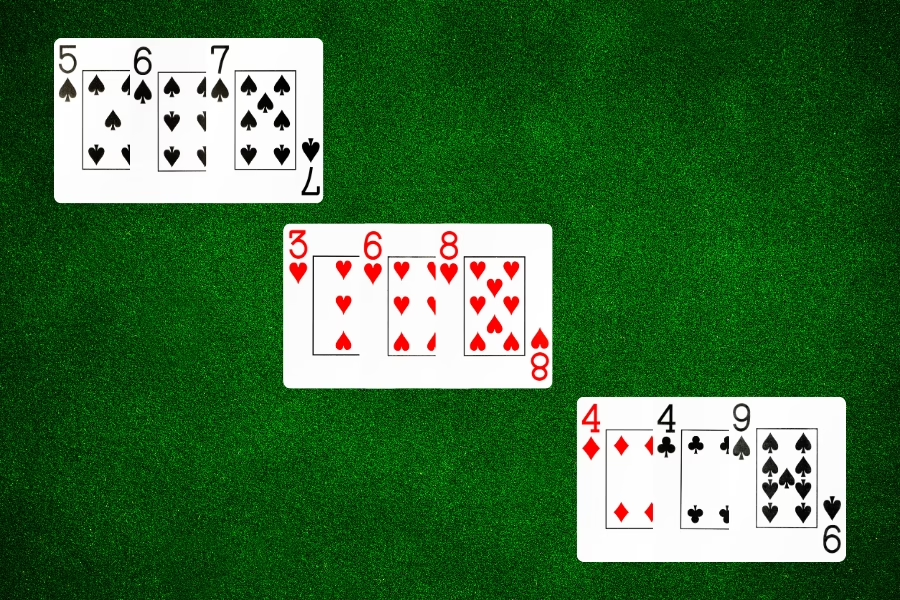
- Low connected boards such as 5-6-7, 6-7-8, or 7-6-4. The big blind’s calling range contains many sets, two pairs, and straights that the button’s opening range largely misses.
- Low monotone boards (for example, 3♥ 6♥ 8♥). The caller has more suited combinations that hit the flush.
- Low paired boards (4♦ 4♣ 9♠). The defender’s range includes more trips combinations that the raiser would not have opened.
On these boards solvers frequently recommend that the big blind donk-bet 20–40% of its range, almost always with a small size.
The goal is to deny equity to the raiser’s high-card hands that would otherwise check back, while still extracting value from the portion of the raiser’s range that continues.
Conversely, donk betting is rarely correct on ace-high or Broadway-heavy boards that strongly favor the raiser’s range.
Leading into those textures with a capped range usually loses value.
Sizing and Range Construction
When solvers choose to donk, they almost always select a small size—typically 25% to 40% of the pot.
A small bet keeps the range wide enough to include both strong value hands and enough bluffs or semi-bluffs.
Larger sizes tend to make the range too transparent and invite the raiser to raise or fold too accurately.
A well-constructed donk range mixes value (sets, two pair, strong straights) with hands that need protection or that can continue on favorable turns (pair-plus-draw, strong gutshots, backdoor flush draws).
Pure air is usually better reserved for check-raise or check-call lines so that the overall strategy remains balanced.
A small donk bet can keep both strong hands and semi-bluffs in the range without making the play too predictable.
How to Respond to a Donk Bet
Against a small donk on a dry or medium board, calling with top pair and decent kickers is often correct; you keep the opponent’s weaker hands in and avoid inflating the pot with a hand that is not strong enough to raise.
On wet, low boards where the caller’s range is genuinely stronger, caution is warranted—raising light becomes less attractive.
Against players who donk only with strong hands (a common leak among recreational players), you can fold more medium-strength holdings and raise more aggressively with your own value.
Against players who donk a wide, mixed range, you should defend more and raise less.
Population tendencies still matter even after solvers have shown that some donk frequencies are theoretically sound.
Practical Takeaways
- A donk bet is simply a lead into the previous street’s aggressor from out of position.
- The name comes from “donkey,” but the play is no longer automatically a mistake.
- Solvers use small donk bets on low, connected, paired, or monotone boards where the caller’s range has an advantage.
- On most high-card boards, checking remains the default.
- When facing a donk, adjust your response to the board texture and to the specific tendencies of the player in front of you.
Used rarely and only on the right textures, a donk bet is a legitimate part of a strong post-flop strategy.
Used constantly or on the wrong boards, it remains a reliable way to give up equity.
The difference lies in knowing which situation you are in.


