What Is a Check-Raise in Poker?

A check-raise is when you check on a street, an opponent bets after you, and you then raise that bet on the same street.
It is almost always an out-of-position play. You give the appearance of weakness by checking, invite a bet, and then come over the top once the opponent has committed chips.
Checking does not close the action. Once another player bets, the option to raise reopens. Under standard rules (including Robert’s Rules of Poker), check-raising is legal in Hold’em and most other forms of poker.
How a Check-Raise Works
The sequence is simple but powerful:
- You act first and check.
- An opponent bets.
- Action returns to you and you raise instead of calling or folding.
This is most common on the flop when the big blind has called a preflop raise and then faces a continuation bet.
It can also occur on the turn or river, though it is rarer later in the hand.
Because the check-raiser acts first, the play is almost exclusively used out of position. In position you can simply raise a bet directly; you do not need the two-step dance.
Why Check-Raising Is So Effective
A well-timed check-raise does three jobs at once:
| It builds a bigger pot with strong hands | Your opponent has already put money in; the raise multiplies that commitment. |
| It applies immediate pressure | Hands with equity (pairs, overcards, weak draws) are forced to fold or pay a high price to continue. |
| It protects vulnerable made hands | That are currently best but hate free cards. |
The psychological element is equally important.
A check looks like weakness or indifference. When the raise arrives, many opponents have already mentally committed to their bet and struggle to adjust.
A check-raise can build a pot, put pressure on an opponent, and protect a made hand—all with one play.
Value Check-Raises vs. Bluff Check-Raises
Every check-raise falls into one of two categories.
Value Check-Raises
You have a strong hand (sets, two pair, straights, or the best top pairs) and want to be called by worse holdings.
Checking encourages a bet from hands that would have folded to a lead.
Once they bet, your raise extracts more money while they still feel comfortable.
Bluff Check-Raises
You want better hands to fold.
The best bluff candidates are draws (flush draws, open-ended straight draws, and strong backdoor draws) that have both fold equity and equity when called.
A balanced strategy mixes roughly two bluffs for every one value hand on the flop so that opponents cannot simply fold everything except the nuts.
If you only ever check-raise the nuts, observant players will fold everything else and you will stop getting paid.
If you only bluff, they will call you down light. Balance keeps both lines profitable.
When to Check-Raise
The best spots share a few common features:
- You are out of position (usually the big blind).
- The board favors your range more than the preflop raiser’s range. Low connected boards (7-6-5, 8-7-6) and low paired boards are classic examples.
- Your opponent is likely to bet frequently or with a small size. Small continuation bets (around one-third pot) often come from a wide range that is vulnerable to a raise.
- You are heads-up. Check-raising into multiple opponents is much riskier.
Wet boards with many draws support larger, more frequent check-raises.
Dry boards favor tighter, value-heavy ranges.
Stack depth also matters: with deep stacks (100bb+) you can use larger multiples; with shorter stacks the raise often becomes a jam or near-jam.
How Big Should You Check-Raise?
There is no single correct size, but useful guidelines exist:
- Against a small bet (quarter-pot or less): raise 3.5–5× the bet.
- Against a standard two-thirds-pot continuation bet: raise roughly 2.5–3.5× the bet.
- On wet boards: lean larger to charge draws.
- On dry boards or with shorter stacks: size down slightly.
A common starting point for 100bb cash games is about 3× the bet you are facing.
Always size relative to the bet, not a fixed percentage of the pot, because the pot has already grown by the time action returns to you.
Clear Examples
Flop Check-Raise for Value
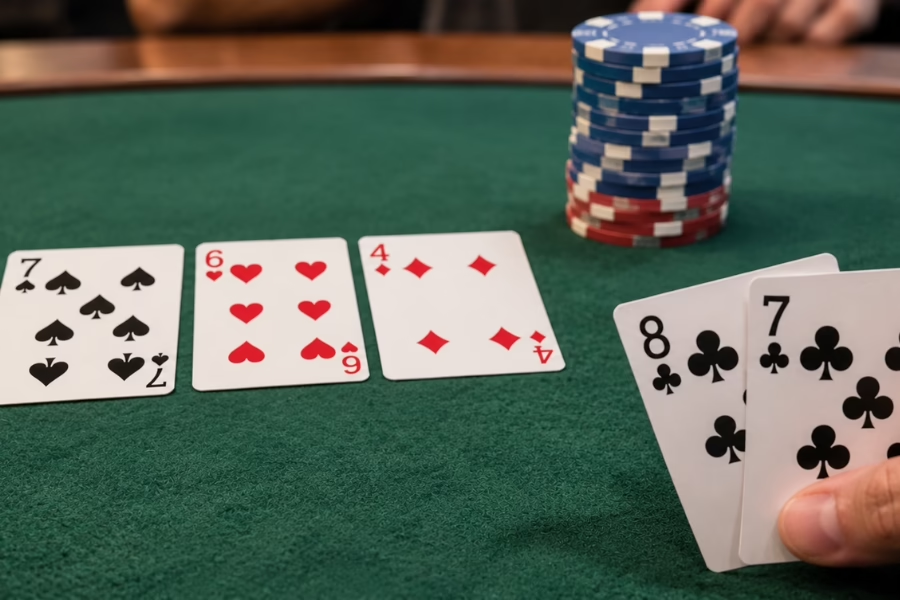
You defend the big blind with 8♣ 7♣ against a button open.
The flop is 7♠ 6♥ 4♦.
You check. The button continuation-bets $25 into a $40 pot. You raise to $85.
You have top pair with a strong draw and range advantage on this low connected board.
The raise builds the pot while many of the button’s overcards and weak pairs must fold or pay a bad price.
Flop Check-Raise as a Bluff
Same preflop action. You hold 9♠ 8♠.
Flop is 7♥ 6♣ 2♠.
You check, button bets small, and you raise.
You have an open-ended straight draw plus a backdoor flush draw.
The raise has fold equity against the button’s air and overcards, and you still have substantial equity when called.
Common Mistakes
- Check-raising only with the nuts. This makes the line too transparent.
- Using the line multi-way. The risk of running into a stronger hand rises sharply.
- Sizing too small on wet boards, giving draws the correct price to continue.
- Checking strong hands on boards where the opponent is unlikely to bet. Sometimes a simple lead is better.
- Ignoring stack depth and turning a check-raise into an accidental over-commit.
Final Thoughts
The check-raise is one of the clearest ways an out-of-position player can seize the initiative.
Used with a mix of strong value hands and well-chosen bluffs on the right boards, it builds pots, denies equity, and keeps opponents guessing.
Master the timing, the sizing, and the range balance, and the line becomes a reliable source of edge rather than a hopeful trap.


