What Is a Bomb Pot in Poker?
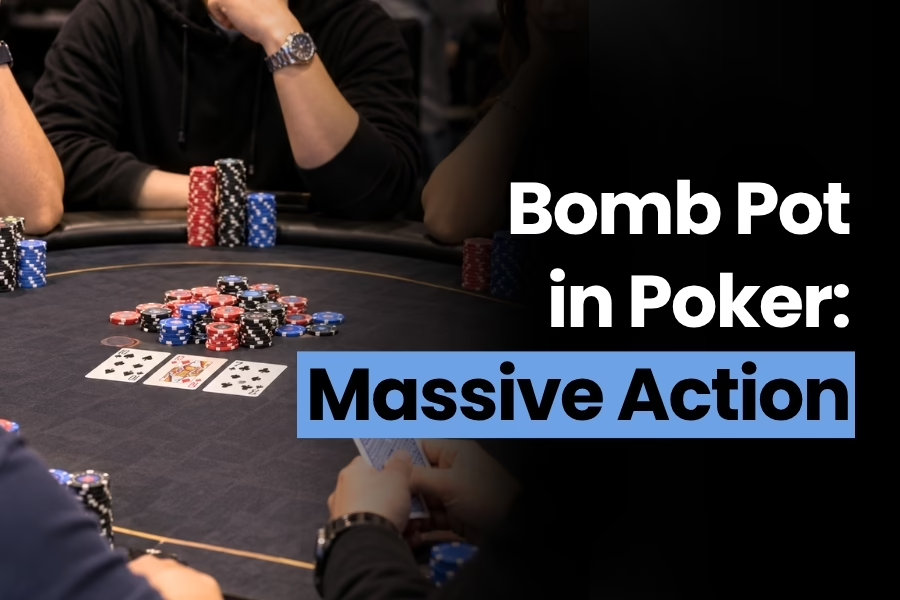
A bomb pot is one of the most action-packed hands you will encounter in live cash games and many home games. Every player at the table puts in the same agreed amount of money before the cards are dealt, there is no preflop betting, and the dealer goes straight to the flop with the entire table still in the hand. The pot is already large before anyone acts, and the result is usually a multiway pot that can grow very quickly.
Bomb pots are not part of the official rules of Texas Hold’em or Omaha. They are a table convention designed to create bigger pots and more excitement. You will see them most often in live no-limit Hold’em and pot-limit Omaha cash games, and they have also appeared in some online games and even a few tournament events.
What Exactly Is a Bomb Pot?
In a standard hand of Texas Hold’em, the small blind and big blind post their forced bets, players look at their hole cards, and a full round of betting occurs before the flop. Players can fold, call, or raise. Many hands never reach the flop.
A bomb pot removes the preflop betting round entirely. Instead of blinds, every player posts a fixed ante. The dealer then deals hole cards to everyone and immediately spreads the flop. Betting begins on the flop, with the first active player to the left of the button acting first. From that point the hand plays out normally, with betting on the flop, turn, and river.
Because no one can fold before the flop, bomb pots are multiway by design.
In an eight- or nine-handed game you will often see six to nine players see the flop. The starting pot is already several times larger than a normal pot, so even modest postflop bets represent a lot of money.
How a Bomb Pot Works
The sequence is straightforward once the table has agreed on the rules:
- The dealer or a player announces that the next hand is a bomb pot.
- Every player posts the agreed ante (for example, $5 or $10 in a $1/$2 game).
- Hole cards are dealt in the normal way (two cards in Hold’em, four cards in Omaha).
- There is no preflop betting. The dealer burns a card and deals the flop (or two flops in a double-board bomb pot).
- Action starts on the flop with the player to the left of the button and continues clockwise.
- The hand proceeds through the turn and river with normal betting rounds.
- At showdown the best hand wins the pot (or half the pot on each board in a double-board version).
Blinds are usually not posted on a bomb pot hand. The antes replace them for that hand only.
Position still matters: the button acts last on every street, which is a significant advantage when the entire table is involved.
Single-Board vs. Double-Board Bomb Pots
There are two main versions.
Single-Board Bomb Pot
In a single-board bomb pot, the dealer deals one normal flop, turn, and river. The entire pot goes to the player with the best five-card hand at showdown (or to the last remaining player if everyone else folds). These hands feel like a very large multiway pot that simply started without any preflop action.
Double-Board Bomb Pot
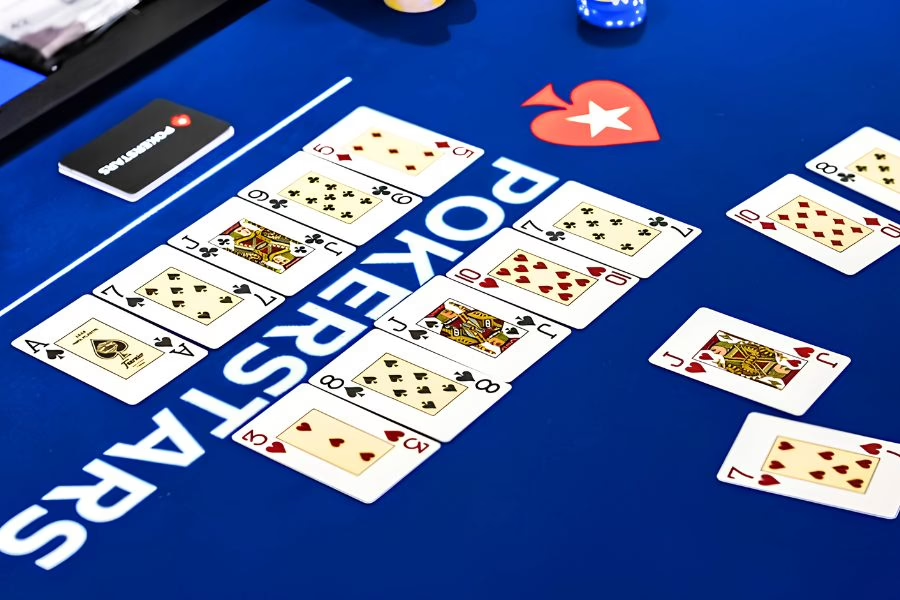
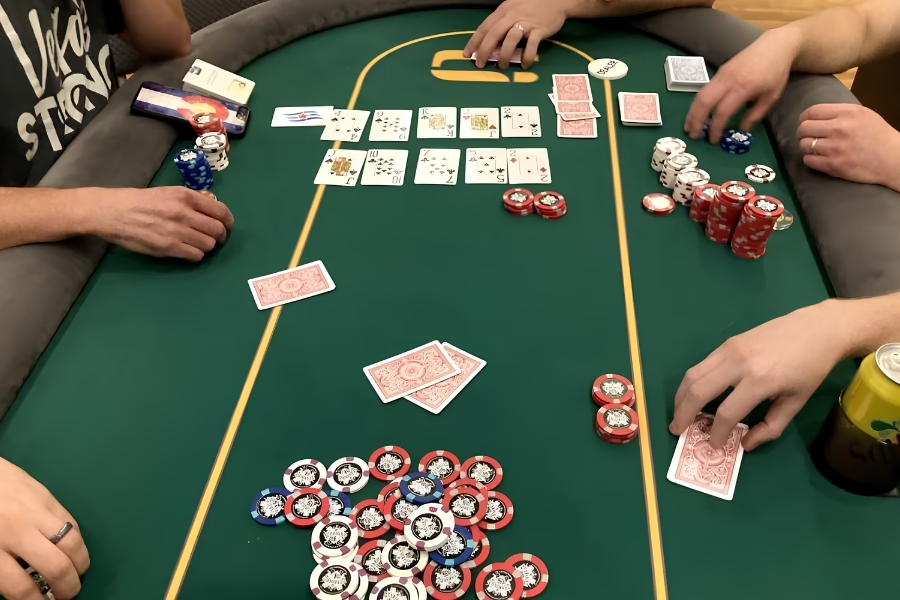
In a double-board bomb pot, the dealer deals two separate boards. There are two flops, two turns, and two rivers. At showdown the pot is split: half goes to the best hand on the first board and half goes to the best hand on the second board.
If the same player wins both boards, they “scoop” the entire pot. If one board is a chop, that half of the pot is split accordingly.
Double-board bomb pots are extremely popular in Omaha games and in many live Hold’em games because they create even more action and more ways for different players to win something. The strategic focus shifts toward hands that can win both boards rather than simply having a strong hand on one board.
Ante Size and How Often They Run
The ante amount and the frequency are set by the table or the card room. Common ante sizes range from roughly one to five big blinds, though some games use larger amounts.
| Game stakes | Example bomb pot ante |
|---|---|
| $1/$2 | $5 or $10 per player |
| $2/$5 | $10 or $20 per player |
With eight players posting $10 each, the pot already contains $80 before the flop is dealt.
Frequency also varies. Some tables run a bomb pot once per orbit (every time the button goes around). Others run one every 30 minutes or every hour. In home games the group may simply call for one whenever they feel like it. Online, some rooms trigger them at fixed intervals or randomly.
Because everyone puts in the same amount with a completely random hand, the bomb pot itself is roughly neutral before the flop (minus any rake). The edge comes from how well you play post-flop in these unusual multiway spots.
Why Players Like Bomb Pots
Bomb pots generate action. Many recreational players enjoy the fact that everyone is in the hand and that large pots develop quickly. They also create interesting strategic situations that do not appear in normal play.
Ranges are completely undefined because there was no preflop betting, so every player could have almost anything.
For the table as a whole they are a high-variance way to move chips around. Skill still matters, but the swings can be large because the pots start big and stay multiway.
Strategy Tips for Bomb Pots
Standard preflop ranges do not apply. You are forced to see the flop with whatever hand you were dealt. Postflop thinking changes in several important ways:
| One-pair hands lose value | Top pair is often a hand you want to control the pot with rather than build a huge pot with, especially when five or more players see the flop. Someone is more likely to have two pair, a set, or a draw that hits. |
| Nut potential becomes more important | Hands that can make the nuts (or strong draws to the nuts) rise in value. Suited connectors and suited gappers that can make nut flushes or straights play better multiway than many big offsuit cards. |
| Position is extremely valuable | With the whole table still in, acting last lets you see how everyone else reacts before you decide whether to bet, call, or fold. |
| Bluffing is harder | Fold equity is lower because so many players are in the pot. Someone usually has a piece or a draw that will continue. Pure bluffs should be rare. |
| In double-board bomb pots, think about scooping | Winning half the pot (and often paying rake on the full pot) is frequently not enough to show a profit. Hands that can win both boards, or freeroll one board while holding strong equity on the other, are the ones worth building big pots with. A set on one board and nothing on the other is often a hand to play more carefully. |
| Bet sizing also tends to be smaller than in heads-up pots. | When many players are still in, large bets get called less often by the right number of opponents, and small-to-medium bets can still extract value while keeping more players in when you want them. |
Live vs. Online and Other Variations
Bomb pots started mainly as a live and home-game feature. They have become common at many cash-game rooms and appear regularly on live-streamed games. Online they are less universal but available on some platforms, either as a special table type or as an occasional feature.
Some tables occasionally run triple-board bomb pots or switch the game (for example, dealing a Hold’em table a hand of Omaha for the bomb pot). Always confirm the exact rules before the first one is dealt: the ante amount, whether it is single- or double-board, which game is being dealt, and whether anyone is allowed to sit out.
Final Thoughts
A bomb pot is a simple but dramatic variation on a normal poker hand. Everyone antes, preflop betting is skipped, and the entire table sees the flop in a pot that is already large. Single-board versions create big multiway pots; double-board versions add the extra layer of scooping versus splitting.
They are not for every player. The variance is high, and the strategic adjustments required are real. Players who tighten their standards for putting more money in, prioritize hands with strong nut potential, and respect the value of position tend to do better than those who treat every flop the same way they would in a normal heads-up pot.
The next time a bomb pot is announced at your table, you will know exactly what is happening and why the pot is about to get interesting. Play carefully, keep an eye on how many players remain, and remember that winning half the pot is not always the same as winning.


