How Many People do you Need to Play Poker

Two can play. A card room often wants more. A home game wants still more. The rules of poker do not require a crowd. They require an opponent.
Two players can post blinds, see a flop, and award a pot. That game has a name: heads-up poker. It is a real format, played for bracelets and for the last two seats of every tournament that does not end in a deal.
Most people who ask the question are not asking about the rulebook. They are asking how many chairs a game needs before it feels like poker.
The answer depends on which of those questions you mean.
The numbers at a glance
| Players | Typical format | What to expect |
|---|---|---|
| 2 | Heads-up | A direct contest between two players |
| 3–4 | Short-handed | Wider ranges and more blind battles |
| 5–7 | Home game | More multiway pots and a fuller table dynamic |
| 6 | Six-max cash | A common online format |
| 8–10 | Full ring | More opponents and tighter early-position play |
| 7–8 | Seven-card stud | A traditional upper range because of deck limitations |
The minimum is two players. The number needed to open a table depends on the card room, the format, and its house rules.
Video poker is a separate case: one player plays against a pay table, with no opponent and no pot.
Two players are enough
Heads-up poker is poker. The button posts the small blind. The other player posts the big blind.
In Texas Hold’em, the button acts first before the flop and last on every later street. Cards are dealt, betting rounds run, and if both players reach showdown, the best hand wins.
Nothing in that sequence needs a third person.
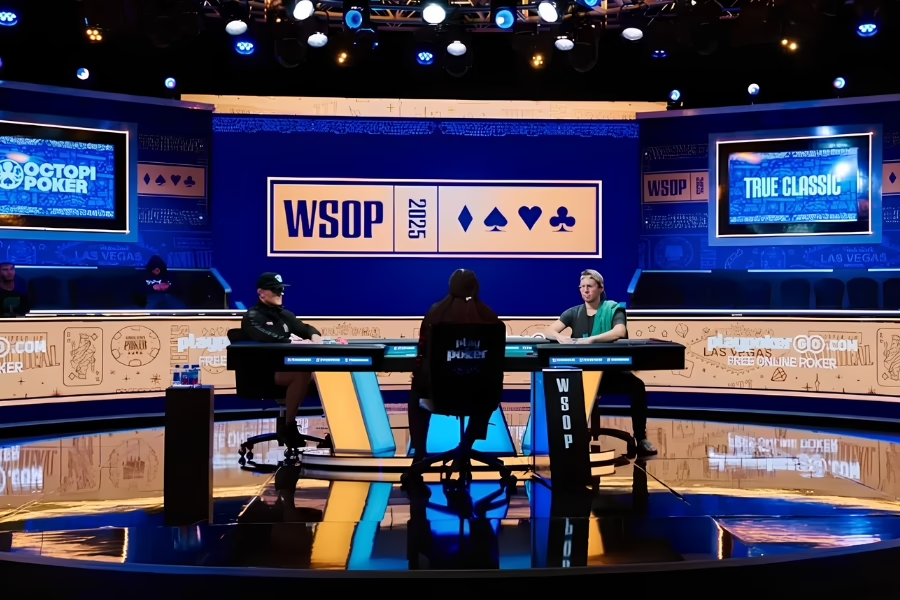
The World Series of Poker runs heads-up events. Online rooms list heads-up cash tables and heads-up sit-and-gos. A tournament that starts with a thousand players is still poker when two remain. The structure did not break. It got smaller.
Why heads-up requires a different strategy
The strategy is not the strategy of a nine-handed game. Ranges are wider. Folding the button is rare, because the button is also the small blind, and the next hand will not offer a better seat.
Stealing, three-betting, and playing marginal hands in position are the ordinary course of the game, not the exception.
A player who brings a full-ring chart to a heads-up match will fold too much and get run over.
Heads-up also removes the thing many people came for. Multiway pots disappear. Table talk comes from just two players, and there is no third chair to trap between the raiser and the caller.
For a serious player that is a feature. For a Friday night game it is a reason to wait.
When does a table start to feel like poker?
Three or Four players
Three-handed poker is the smallest game that still has a player who is not in the blinds. The button, the small blind, and the big blind are three different people.
Someone can fold and leave a heads-up pot. Someone can call and make it multiway. The shape of a real table is there, even if the ranges stay wide.
Many card rooms will not deal a cash game heads-up. House rules vary. Some rooms open a table at three. Some want four. A few will deal heads-up if both players agree and the game is listed that way.
The reason is practical more than philosophical. A two-handed cash game generates less rake per hour than a full table, and it tends to break when one player stands up. A floor that spreads a new game is trying to build a table, not host a match.
Four-handed is where a home game starts to work if the players are patient. There is a cutoff. There are blind-versus-blind pots that are not the whole game. Pots can go three ways.
It is still short-handed. Opening ranges should be wide, and a player who waits for pocket aces will not see many of them.
Five to Seven players
Five players is the point at which a lot of home games stop feeling short. The button has a real advantage. Limpers can appear. A raise can get two callers.
Position matters across more than one opponent, which is the skill most players mean when they say they are learning poker.
Six is the number online cash games settled on. Six-max replaced full ring as the default format on the big sites because the game is faster, the average pot is more contested, and a player waiting to act is not watching five people fold.
Live poker did not follow. A card room still spreads nine-handed and ten-handed Hold’em, because seats are the product and a full table rakes more.
Seven sits between those worlds. It is large enough for a full orbit to take a while, and small enough that the blinds come around before the table goes quiet.
Mixed games and dealer’s choice nights often land here, because a stud hand and a Hold’em hand can share the same group without anyone waiting out a ten-handed orbit.
Eight to Ten players
Nine-handed is the modern full-ring standard in many card rooms. Ten-handed is the older standard, and some rooms still use it.
The World Series of Poker has used both, depending on the year and the event. Online full ring, when it is spread at all, is almost always nine.
More players change the math before they change the rules. A pocket pair is about one hand in seventeen either way. The chance that someone else at the table woke up with a better one goes up as chairs fill.
Opening from early position with a wide range is a mistake at ten-handed that would be standard at four-handed. The player under the gun at a full table has eight or nine people left to act. The player on the button has two, and both of them already have a blind in the middle.
That is why full ring looks tight on television and loose in a short-handed home game, even when the players are the same people. The cards did not get better. The number of opponents did.
Full ring also has a social shape that short-handed poker does not. An orbit takes longer. Conversation fills the folds. A player can sit out a few hands without the game collapsing.
For a cash game meant to last four hours, nine players is often easier to hold together than four, because one person taking a phone call does not leave the table short.
When the deck sets the limits
The number of players is not always a matter of preference. Some variants have practical limits because of how many cards they use.
Texas Hold’em and Omaha
Hold’em and Omaha do not run out of cards at a normal table. In Hold’em, each player takes two hole cards and the board takes five.
Ten players need twenty-five cards if every hand goes to showdown, and the burn cards add a few more. The deck holds fifty-two. The constraint is the table, not the deck.
Rooms cap Hold’em at nine or ten because that is what fits, and because the action dies if the table gets larger.
Seven-Card Stud, Razz, and Stud High-Low
Stud games are different. Seven-card stud deals each player up to seven cards, with no shared board.
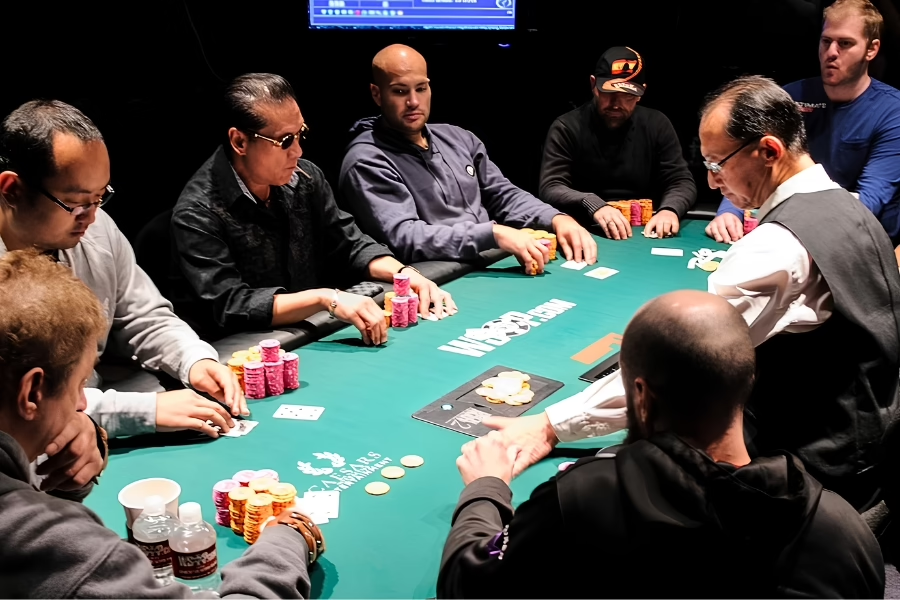
If eight players took the hand to seventh street, the deck would be short. Players fold, so the cards usually last, but the traditional maximum is seven or eight.
Razz and stud high-low use the same cap. A host who wants to deal stud to ten people is going to reshuffle a muck or run out of cards. Neither is a good fix.
Five-Card Draw and Lowball
Five-card draw has the same problem in a milder form. Each player takes five cards and may draw replacements. Six to eight is the usual table.
Deuce-to-seven and other lowball draw games follow that limit.
Open-Face Chinese and Pineapple-Style Games
Open-face Chinese and other pineapple-style games are often played with two, three, or four. The hands are large. The fouling rules assume a small group.
Adding a fifth player is possible in some variants and awkward in others.
Video Poker Is Different
Video poker is the exception people mix in. It is played alone. The machine pays on a posted table. There is no opponent, no bluff, and no pot.
It uses poker hand rankings. It is not a poker game in the sense of this question.
The formats players actually sit down to
The count is part of the product in some games and a house choice in others.
| Format | Typical table | Minimum to deal | Usual cap |
|---|---|---|---|
| Heads-up cash or sit-and-go | 2 | 2 | 2 |
| Jackpot sit-and-go | 3 | 3 | 3 |
| Six-max cash | 6 | 2, often 3 or 4 live | 6 |
| Live full-ring cash | 9 or 10 | 2, often 3 or 4 to open | 9 or 10 |
| Home game, Hold’em | 6 to 9 | 2 | 9 or 10 |
| Seven-card stud, razz | 6 to 8 | 2 | 7 or 8 |
| Five-card draw | 6 to 8 | 2 | 6 to 8 |
| Tournament field | Any listed field | 2 at the end | Thousands |
House rules can raise the minimum. The deck, not the house, sets the stud cap.
Tournaments have their own numbers
A tournament can start with any field the structure can hold. Two players can play a heads-up sit-and-go. Three-handed hyper-turbo games, the format behind most jackpot sit-and-gos, are built for exactly three.
A six-max sit-and-go starts with six. A daily tournament in a card room might start with thirty. The World Series of Poker Main Event has started with several thousand.
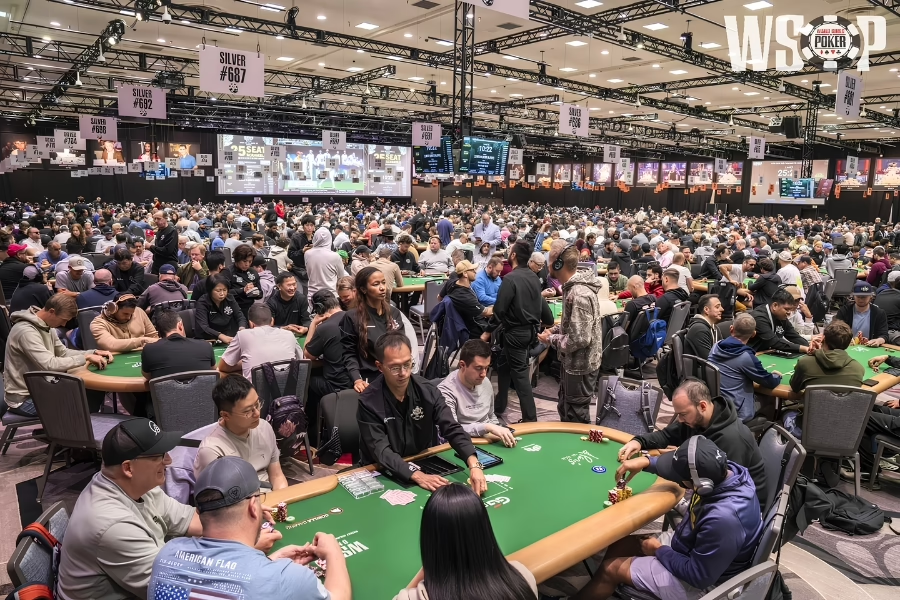
The minimum inside a tournament is still two, unless the remaining players make a deal and end it earlier. Tables break as players bust.
Near the money and at the final table, the count is a rule, not a preference. A final table might be nine-handed. A six-max event finishes six-handed, then plays down.
Sit-and-Gos and Jackpot Formats
Sit-and-gos make the count part of the product. A player who registers for a nine-handed sit-and-go has agreed to a game that starts when the ninth chair fills. A jackpot sit-and-go starts when the third player clicks in.
The format is the answer to the question.
When Players Make a Deal
A deal changes the ending, not the game. Two or three players left in a tournament can agree to split the remaining prize pool by chip count, by ICM, or by some number they invent at the table.
If they do, the event ends without a heads-up match. The cards would still have worked. The players chose not to deal them.
What a card room will actually deal
House rules sit on top of the game rules. A room can refuse a heads-up cash game even though the hand can be dealt.
Common patterns include:
- A new table opens at three or four players.
- Heads-up is allowed only in a listed heads-up match, or at the end of a tournament.
- A game that drops to two may be broken, with both players offered a seat elsewhere.
- A must-move table feeds a main game and does not run on its own below a set count.
- Rake is a percentage with a cap, so a short table earns the house less per hour.
None of that changes the hand. It changes whether the floor will spread it.
A player who wants heads-up cash should ask before sitting down, or look for a room and a limit where that game is listed.
Planning to home game
For a home game, the useful number is not the minimum. It is the number that survives no-shows.
Invite more people than the table holds. If the target is seven, invite nine or ten.
Poker invitations have a soft response rate. One person works late. One person cancels in the driveway. A host who invites exactly six often deals to four.
How many should you invite?
Six to nine is the range that fits a standard dining table and a single deck of Hold’em. Below five, tell people in advance that the game will be short-handed, so nobody arrives expecting a full orbit of folds.
Above nine, split into two tables or cut a player rather than deal eleven-handed Hold’em. Eleven-handed is possible in the narrow sense that the deck can survive. It is a poor game.
Early position is a guess, and the button takes forever to arrive.
Agree on the house rules first
A few house choices matter more once the count is set:
- Agree on the buy-in before anyone sits.
- Agree on whether the game breaks if it drops to three.
- Agree on who deals, or rotate the deal with the button.
- Decide what happens to a short stack who wants to leave. A cash game can continue. A freezeout cannot replace them.
A home game that starts with eight and loses two at midnight is still a game. A home game that has not decided whether three players is enough will spend the last hour negotiating instead of dealing.
How player count changes strategy
The same hand is not the same hand at every table size.
A suited connector in late position is a standard open at five-handed and a fold from under the gun at full ring. A small pair wants multiple callers so it can set-mine, which is a full-ring plan, and it wants to be played more aggressively short-handed, where seeing a cheap flop is harder to arrange.
Blind-versus-blind confrontations are an occasional pot at nine-handed and a large share of the game at three-handed.
Adjusting is not optional. A player who uses one chart for every seat count is leaving money in the chairs that do not match it.
The adjustment is mostly preflop:
- Open wider as the table shrinks.
- Defend the blinds more often when the opener is stealing every orbit.
- Give multiway pots more respect when four people have seen a flop, because someone is more likely to have connected.
Variance and Attention
The count also changes the variance and the attention. Heads-up is a high-decision game. Almost every hand is played. Full ring is a waiting game. Most starting hands are folded.
A recreational player who came to see flops will be happier at six-max than at a tight ten-handed table. A player who came to talk will be happier at nine.
Stack Depth Still Matters
Stack depth interacts with the count, but it does not replace it. A deep-stacked three-handed game still plays wider than a deep-stacked nine-handed game.
The extra money makes speculative hands more playable. It does not create the folded orbits of a full table.
A short-stacked full ring, late in a tournament, plays tight for a different reason: the next blind increase is the opponent, and most hands are not worth the chips already posted.
So, how many people do you need?
You need two people to play poker. That is the rule, and it is a complete game.
Most card rooms need three or four players before opening a cash table. With around six, the game starts to resemble the poker many players picture, complete with positional battles, multiway pots, and a button worth fighting for.
Traditional full-ring games usually seat nine or ten players, while stud is generally capped at seven or eight because of deck limitations.
If the question is whether to deal the next hand, deal it at two. If the question is whether to host the night, fill six seats and invite a couple more.


