What Is a Full House in Poker?
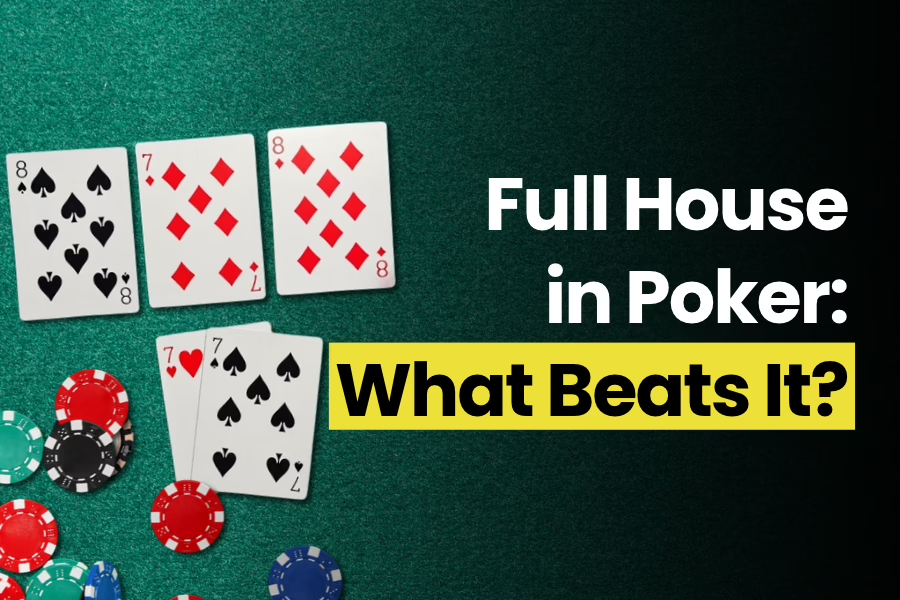
A full house is one of the strongest hands in poker. It consists of three cards of one rank and two cards of another rank. In everyday language it is often called “a full boat” or simply “a boat.” On the standard ranking chart it sits above a flush and below four of a kind.
New players sometimes confuse it with two pair or with three of a kind alone. The distinction matters. A full house requires both the three of a kind and the pair. Holding three aces with two unpaired cards is only three of a kind. Holding three aces and a pair of kings is a full house.
Because the combination is relatively rare, a full house usually wins large pots. Understanding how it is formed, how it is ranked against other full houses, and how board texture can create it helps players avoid expensive mistakes.
The Short Answer
A full house is three cards of one rank plus two cards of another rank (for example, three kings and two sevens).
It beats a flush, a straight, three of a kind, and every lower hand. It loses to four of a kind, a straight flush, and a royal flush.
When two players both have full houses, the one with the higher three of a kind wins. If the three of a kind ranks are equal, the higher pair wins.
What Makes a Full House?
The definition is precise. You need five cards that form exactly one three-of-a-kind and one pair. The remaining cards, if any, do not count. In five-card stud or five-card draw the hand is simply those five cards. In Texas Hold’em or Omaha the best five-card combination is chosen from the seven or nine cards available.
Examples:
- A♦ A♣ A♥ K♠ K♥ — a full house, aces full of kings.
- 10♠ 10♥ 10♦ 4♣ 4♦ — tens full of fours.
- Q♥ Q♦ Q♣ 9♠ 9♦ — queens full of nines.
If you hold three of a kind and the other two cards do not match each other, you do not have a full house.
Three jacks, an eight, and a five is only three of a kind.
The same rule applies on the board. A paired board with three of a kind already present does not automatically give everyone a full house; each player still needs the matching pair or the matching three.
In community-card games the full house can be made in several ways. Both hole cards can be used (for instance, pocket aces on a board of A-K-K). One hole card can pair the board while the other completes the three of a kind. Or the board itself can contain the full house and the player simply plays the board. All of these are valid.
Where It Sits in the Rankings
Standard poker hand rankings, from strongest to weakest:
- Royal flush
- Straight flush
- Four of a kind
- Full house
- Flush
- Straight
- Three of a kind
- Two pair
- One pair
- High card
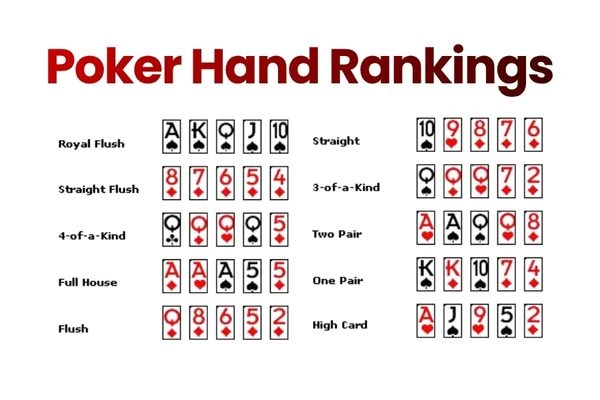
This is why a player who flops a flush on a paired board must remain cautious: any opponent who holds the matching pair or the matching three of a kind has a full house that wins.
The relative ranking of full houses themselves is determined first by the three of a kind, then by the pair.
Aces full of deuces beats kings full of queens. If both players have the same three of a kind (rare in Hold’em but possible when the board supplies it), the higher pair wins. Suits never matter when comparing full houses.
Full Houses in Texas Hold’em
Most recreational and tournament play happens in Texas Hold’em. In that game each player is dealt two private cards and five community cards are dealt face up. The best five-card hand using any combination of the seven cards wins.
Common ways a full house is completed:
- Pocket pair on a board that contains three of a kind or a pair plus one matching card.
- Two cards of different ranks on a board that pairs both of them and supplies a third of one rank.
- One hole card that matches a pair on the board while the board also contains three of another rank.
- The board itself shows a full house and every player shares it (or improves it with a better kicker that does not matter).
Board texture is critical. A flop of A-K-K is extremely dangerous for anyone holding a flush draw or a straight draw. Anyone with an ace or a king already has a full house or better.
A flop of 9-9-4 is less threatening unless a player holds a nine or a four. Players who ignore paired boards and continue with medium flushes often lose large pots.
In multiway pots the chance that someone has completed a full house rises quickly once the board pairs. A single raise on a paired flop often means someone has at least two pair or a set; a three-bet or a large overbet frequently means a full house is already made.
How Often Full Houses Appear
In a randomly dealt five-card hand the probability of being dealt a full house is approximately 0.144 percent, or roughly 1 in 694 hands.
That is rarer than a flush (about 0.197 percent) and far rarer than a straight.
In Texas Hold’em the numbers change because players choose the best five cards out of seven. A player who starts with a pocket pair will flop a full house roughly 0.74 percent of the time when both hole cards are used with a three-of-a-kind board, but more realistic paths exist. Overall, full houses are still uncommon enough that they usually represent the nuts or near-nuts on many boards.
The practical takeaway is simple: when you make a full house you are usually ahead, but you must still consider whether four of a kind or a straight flush is possible.
On a board of A-A-A-K-K the full house is strong, yet any player holding the case ace has quads. On a board of 8-9-10-J-Q of the same suit the full house loses to a straight flush.
Playing a Full House
When you hold a full house the default approach is to extract value. Most opponents will not fold medium flushes, two pair, or sets on many boards. Betting for value on the turn and river is usually correct unless the board has become so scary that only better hands continue.
The main exceptions are boards that contain four of a kind possibilities or straight-flush possibilities. If the board is A-A-A-K and you hold K-K, you have the nut full house, but any opponent who holds the fourth ace has quads. In such spots, checking or using smaller sizing can be preferable to building a huge pot that only loses to the rare better hand.
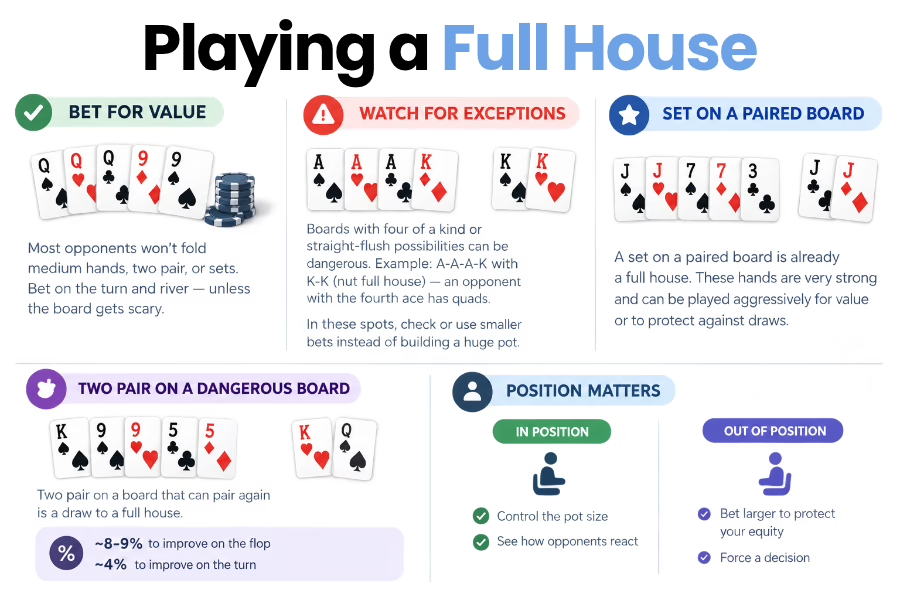
On the draw side, a player who flops a set on a paired board has already made a full house. These hands are extremely strong and can be played aggressively for value or as protection against flush and straight draws.
Conversely, a player who flops two pair on a board that can pair again is drawing to a full house; the odds of improving by the river are roughly 8–9 percent on the flop and about 4 percent on the turn.
Position matters. In position you can control the size of the pot and see how opponents react before committing more chips. Out of position you often need to bet larger to protect your equity or to force a decision.
The absolute strength of the full house does not remove the need for good bet sizing and board reading.
Common Mistakes
- Thinking a flush beats a full house. It does not.
- Confusing three of a kind with a full house when the other two cards do not pair.
- Ignoring a paired board and calling large bets with a non-nut flush.
- Overvaluing a small full house on a board that can make four of a kind or a straight flush.
- Assuming the higher pair wins when two full houses have different three-of-a-kind ranks. The three of a kind is compared first.
- Failing to consider that the board itself may give everyone the same full house, making the pot a chop unless someone has a better one.
Final Thoughts
A full house is a powerful and recognizable hand. Once the ranking rules and the comparison method are clear, most confusion disappears. The remaining skill lies in reading the board: knowing when your full house is nearly unbeatable, when a better full house or quads is possible, and how much value you can safely extract.
The next time a paired board appears, ask three questions:
- Do I have a full house or am I drawing to one?
- Does anyone else have a better full house?
- Is four of a kind or a straight flush possible?
Answering those three questions correctly covers the majority of situations in which a full house decides a pot.