What Is a Flush in Poker?

A flush is five cards of the same suit. The ranks can be anything. They do not have to form a sequence. If they do form a sequence, the hand becomes a straight flush, which is a different and stronger hand.
In standard poker hand rankings a flush sits above a straight and below a full house.
Players who are new to the game often mix the two up. A straight looks orderly. A flush can look like a pile of unmatched cards that happen to share a color.
The ranking does not care about order. It cares about how rare the combination is.
In a 52-card deck there are fewer ways to make a flush than a straight, which is why the flush ranks higher.
Most arguments at the table about flushes come from one of three places: someone thinks a straight should beat it, someone thinks the suit matters when two flushes collide, or someone forgets that a paired board can make a full house that beats both.
Once those three points are clear, the hand becomes straightforward.
The Short Answer
A flush is five cards of the same suit that are not in sequence.
It beats a straight, three of a kind, two pair, one pair, and high card. It loses to a full house, four of a kind, a straight flush, and a royal flush.
When two players both have a flush, the one with the highest card wins. The suit itself does not matter.
What Makes a Flush?
The rule is simple. All five cards must share the same suit: hearts, diamonds, clubs, or spades. The cards can be scattered across the ranks.
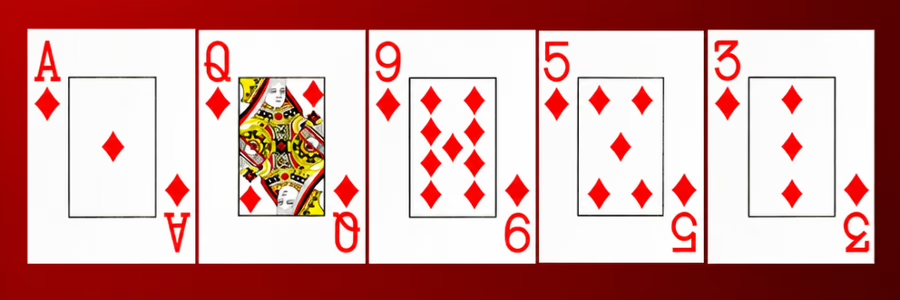
Ace of hearts, nine of hearts, six of hearts, four of hearts, and two of hearts is a flush. So is king of spades, jack of spades, eight of spades, five of spades, and three of spades.
If the five cards are also consecutive, the hand is promoted. It is no longer a plain flush. It is a straight flush.
A royal flush is the highest possible straight flush: ace, king, queen, jack, and ten of the same suit. These are separate entries on the ranking chart. A regular flush does not include them.
Making a Flush in Texas Hold’em
In Texas Hold’em you make a flush by combining your two hole cards with the community cards on the board.
You need at least three cards of your suit on the board, or two on the board plus both of your hole cards.
A board with three hearts already gives anyone holding a heart a four-flush (a flush draw). A board with four hearts means anyone with one heart has a flush.
You can also make a flush with only one of your hole cards if the board has four cards of the same suit. In that case the flush is shared by every player who holds a card of that suit, and the highest hole card of that suit wins.
On a four-flush board the nuts is usually the ace of that suit, and everyone else is drawing dead or playing for a split if no one holds it.
Where the Flush Ranks
The standard poker hand rankings, from strongest to weakest, is:
- Royal flush
- Straight flush
- Four of a kind
- Full house
- Flush
- Straight
- Three of a kind
- Two pair
- One pair
- High card
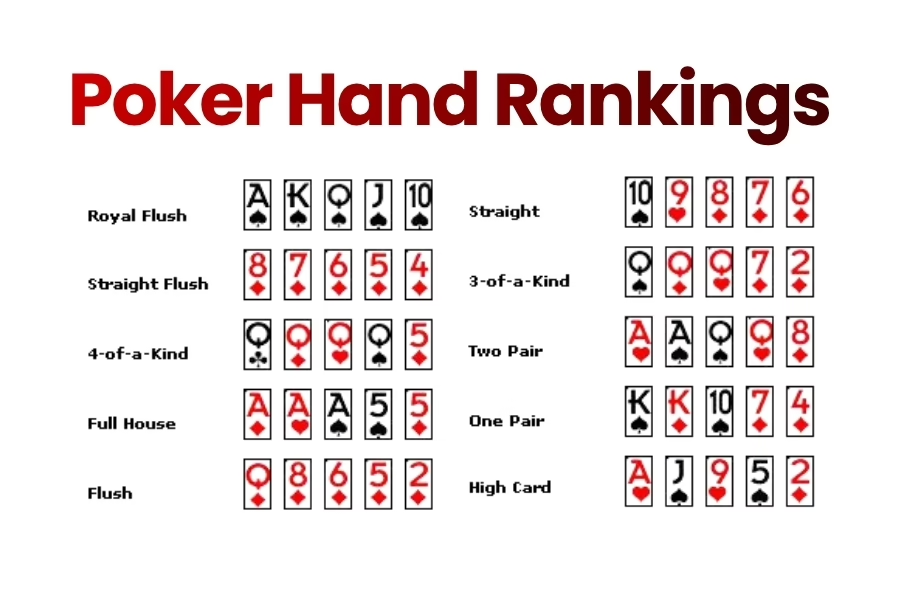
The lowest possible flush (seven-five-four-three-two of one suit) still beats the highest possible straight (ace-king-queen-jack-ten of mixed suits). That surprises some players the first time they see it.
The reason is pure frequency. There are 10,200 ways to make a straight in five cards and only 5,108 ways to make a flush once straight flushes are removed from the count.
Rarer hands rank higher. That is the entire logic of the chart.
How Flushes Are Ranked Against Each Other
The suit does not matter. A heart flush does not beat a spade flush simply because it is hearts.
The hands are ranked by the highest card, then the next highest, and so on.
- An ace-high flush always beats a king-high flush.
- A king-jack flush beats a king-ten flush because the second card is higher.
- If the top four cards are identical and only the fifth differs, the higher fifth card wins.
- Only when all five cards are the same ranks do the hands split the pot.
The Nut Flush
The strongest possible flush is an ace-high flush, often called the nut flush when the ace is the highest available card of that suit.
On a board with three hearts, the player holding the ace of hearts has the nut flush. Anyone else with a heart has a flush that can lose to that ace.
On a board with four hearts the situation is simpler and more dangerous. The player with the ace of hearts has the nut flush. The player with the king of hearts has the second-nut flush.
Everyone else with a heart is hoping the ace and king are both in the muck or still to come.
Playing a medium flush hard on a four-flush board is one of the more expensive habits in the game.
Plain Flush, Straight Flush, and Royal Flush
These three hands share the same suit-based idea, but their rankings are different.
Plain Flush
A plain flush is five cards of one suit that are not consecutive.
Straight Flush
A straight flush is five consecutive cards of one suit.

Example: Nine of clubs, eight of clubs, seven of clubs, six of clubs, five of clubs.
This hand beats any plain flush, any full house, and any four of a kind. Only a higher straight flush beats it.
Royal Flush
A royal flush is the highest straight flush: ace, king, queen, jack, and ten of the same suit.
Nothing beats it. Two royal flushes of different suits split the pot. You will almost never need this rule in practice, but it still sits at the top of the list.
Players sometimes describe a straight flush as “a flush that also straightened” or “a straight that also flushed.” Both descriptions undersell it.
It is its own category, two places above a plain flush and one place above four of a kind.
How Often Flushes Occur
In a five-card poker hand dealt from a full 52-card deck, the probability of a flush (excluding straight flushes) is roughly 0.1965 percent, or about 1 in 509 hands.
A straight is more common, which is why it ranks lower.
In Texas Hold’em the numbers look different because you start with two hole cards and share five community cards.
| Situation | Approximate probability |
|---|---|
| Flopping a flush when dealt two suited cards | 0.84% (roughly 1 in 119) |
| Flopping a flush draw | 10.9% |
| Completing a flush draw from the flop by the river | About 35% |
Once you have a flush draw on the flop, you have about a 19 percent chance to hit on the turn and about a 35 percent chance to complete it by the river.
These odds are why suited connectors and suited aces are popular starting hands. The flush potential gives them extra value beyond the raw strength of the ranks.
A hand like ace-king suited is stronger than ace-king offsuit for the same reason: the flush equity adds a meaningful amount of expected value over the long run.
Backdoor Flush Draws
Backdoor flush draws are weaker but still real. If the flop brings one card of your suit, you need both the turn and the river to hit the other two.
The chance is only about 4 percent, but in deep-stacked pots the implied odds can still justify seeing the turn cheaply.
Flush Draws and Practical Strategy
A flush draw is four cards of the same suit. You need one more.
There are usually nine outs (the remaining cards of that suit). The common shortcut is the rule of four and two:
- On the flop: Multiply your outs by four to estimate your chance of hitting by the river (9 × 4 = 36 percent).
- On the turn: Multiply by two (about 18 percent to the river).
Playing Nut and Lower Flush Draws
Nut flush draws are especially valuable. If you hold the ace of the suit, your draw is to the best possible flush.
You can often play these aggressively, both as value when you hit and as a semi-bluff when you miss. Lower flush draws can still be profitable, but you must be more careful when the board is paired or when a higher flush is possible.
Reading Monotone Boards
On a monotone flop (three cards of the same suit) the dynamics change quickly. Anyone with one card of that suit has a flush.
Betting large with a weak flush can be expensive if an opponent holds the nut flush. Checking or calling is often better than raising when you do not have the ace.
A flush is not always the nuts. On a paired board a full house is possible. On a board with four cards of one suit the flush is common and the full house or quads become the real danger.
Reading the board texture matters as much as the raw strength of the hand.
Flushes in Multiway Pots
In multiway pots the value of a non-nut flush drops further. More players mean more chances that someone holds the ace or a full house.
In heads-up pots you can play medium flushes more confidently. The number of opponents is part of the decision.
Common Mistakes
- Assuming a straight beats a flush. It does not.
- Overvaluing a weak flush on a monotone board.
- Ignoring the possibility of a full house when the board pairs.
- Chasing a flush draw without enough pot odds or implied odds.
- Thinking the suit matters when comparing two flushes. It does not.
- Playing a second-nut flush as if it were the nuts on a four-flush board.
Final Thoughts
A flush is one of the stronger hands in poker and one of the more recognizable.
Once you know the ranking, the comparison rules, and the basic odds, most of the confusion disappears. The rest is practice: recognizing when your flush is the nuts, when it is vulnerable, and when the draw is worth chasing.
The cards do not change. The decisions around them do.
The next time a three-suited board hits the flop, the first question is not whether anyone has a flush. It is whether you have the best one, whether a full house is possible, and how many opponents are still in the hand.
Those three questions cover most of the strategic ground.