What Does It Mean to Have the Nuts in Poker?
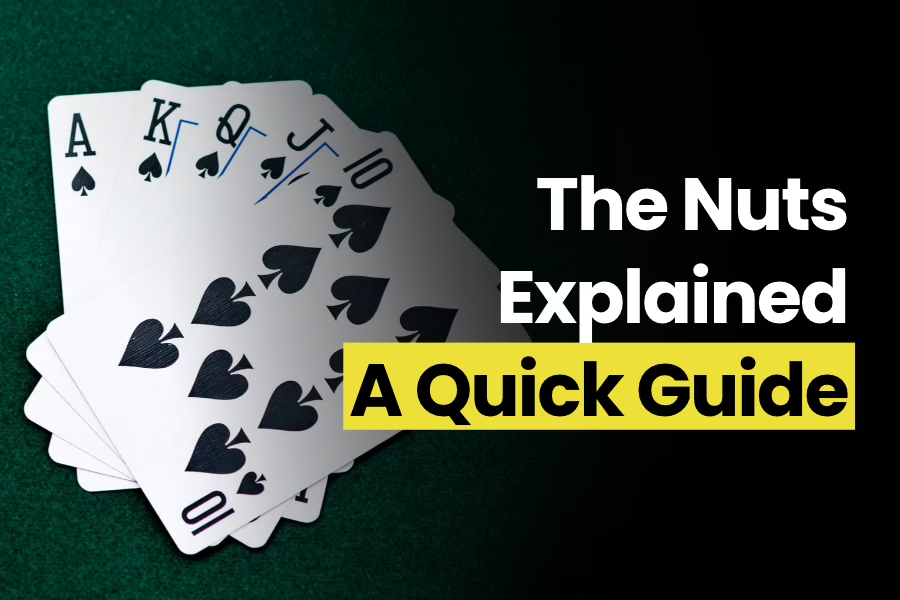
In poker, few phrases carry as much weight as “I have the nuts.” When a player announces or realizes they hold the nuts, it means they have the absolute best possible hand given the community cards on the board. No other combination of hole cards can beat them at that moment.
Understanding the nuts is fundamental to poker strategy. It affects how you bet, when you raise, and how you value your hand relative to your opponents.
Whether you’re playing Texas Hold’em, Omaha, or another community-card variant, recognizing when you have the nuts — and when you don’t — separates skilled players from those who merely hope for the best.
What Are the Nuts in Poker?
The nuts (also called the nut hand) is the strongest possible five-card hand that can be made using the community cards currently on the board and any two hole cards a player might hold.
If you have the nuts, you cannot lose the hand at showdown unless you muck it or the rules of the game create a rare exception (such as a split pot in a high-low game).
Important points:
- The nuts are determined by the board. They change as new cards are dealt.
- You can have the nuts on the flop, the turn, or the river.
- Pre-flop, pocket aces are often called the “pre-flop nuts,” but true nuts are a post-flop concept because a complete hand requires five cards.
- A royal flush is always the nuts, but the nuts can be as weak as three-of-a-kind on certain boards.
Where Does the Term “the Nuts” Come From?
The origin of the term is uncertain and surrounded by colorful stories. The most famous (though almost certainly apocryphal) tale dates to the American Old West.
When a player ran out of money, he would remove the nuts from the wheels of his wagon and place them on the table as a bet. Because the wagon could no longer move, he was forced to stay and settle the debt.
Players only made such a bet when they held the best possible hand, and the phrase gradually stuck.
Other theories suggest the term comes from older English slang in which “nuts” meant something excellent or a source of pleasure, or from the expression “the dog’s bollocks” / “the mutt’s nuts” meaning the absolute best.
Whatever the true origin, “the nuts” has been part of poker language for generations and remains one of the game’s most iconic terms.
How to Identify the Nuts
To determine whether you have the nuts, ask yourself: “Is there any combination of two cards that can make a better hand than mine using this board?”
Key Considerations
- Flush possibilities: If three or more cards of the same suit are on the board, a flush (or straight flush) may be the nuts.
- Straight possibilities: Look for connected cards that allow higher or lower straights.
- Full houses and quads: Paired boards often make full houses or four-of-a-kind the nuts.
- Blockers: Cards you hold that prevent opponents from making the absolute best hand can turn your hand into the effective nuts.

Classic Examples in Texas Hold’em
Example 1: Nut Straight
Board: 10♣ J♠ Q♥ K♦ 2♣
Your hand: A♥ 9♠
You have the Broadway straight (A-K-Q-J-10). No higher straight is possible, and there is no flush. This is the nuts.
Example 2: Nut Flush
Board: A♥ 8♥ 4♥ 2♠ K♣
Your hand: Q♥ J♥
You have the nut flush (ace-high flush). Any other heart is a lower flush and loses to you.
Example 3: Set of Kings as the Nuts
Board: K♦ 7♣ 2♠
Your hand: K♣ K♥
You have a set of kings. No full house or quads are possible yet, and there is no flush or straight draw that beats trips. Your set is the nuts on this flop.
Example 4: Straight Flush
Board: 5♠ 6♠ A♣ 9♠ 5♥
Your hand: 7♠ 8♠
You have a 9-high straight flush. This is the absolute nuts — nothing can beat it.
Absolute Nuts vs. Effective (Relative) Nuts
The absolute nuts is the single best hand that is mathematically possible given the board. The effective nuts (or relative nuts) is the best hand that is realistically possible based on the cards that have been dealt and the actions in the hand.
Example: Board is K♠ K♥ 7♣ 2♦ 3♠. You hold K♦ 7♦. You have kings full of sevens.
Another player cannot have two kings (there are only three left in the deck, and you hold one). Therefore, your full house is the effective nuts even if the absolute nuts would theoretically be four kings.
Skilled players constantly recalculate both. Knowing you have the effective nuts lets you play more aggressively when the absolute nuts is blocked.
Second Nuts, Third Nuts, and Beyond
The second-best possible hand is called the second nuts. The third-best is the third nuts, and so on. These hands are still very strong but carry risk.
Classic trap: You hold the second-nut flush. On a board with three hearts, an opponent with the ace of hearts has the nuts.
Betting large with the second nuts can cost you a big pot if the nut flush is out. Many players prefer to check-raise or play more cautiously with the second nuts when the absolute nuts is possible.
How to Play When You Have the Nuts
Having the nuts is powerful, but how you play it determines how much value you extract.
| Value bet | Against opponents who can call with worse hands, bet for value. Size your bets to get called by second-best hands. |
| Slow-play carefully | Checking or calling can induce bluffs, but it also risks giving free cards that improve your opponent’s hand or allow them to catch up. |
| Protect the pot | On wet boards (many draws), betting to charge draws is often correct even with the nuts. |
| River play | On the river, the nuts is locked in. You can safely bet large or shove, knowing you cannot be beaten. |

The Nuts in Other Poker Variants
In Omaha (especially Pot-Limit Omaha), the concept is the same but more complex because players use four hole cards and must use exactly two of them.
The nuts changes more frequently, and “nut low” becomes important in high-low split games such as Omaha Hi-Lo.
In Stud games, the nuts is determined by the up-cards visible to everyone. Players track which ranks and suits have been exposed to calculate the best possible hand.
Common Mistakes Players Make
- Assuming pocket aces are always the nuts after the flop.
- Failing to notice a possible straight flush or higher flush.
- Slow-playing the nuts on a dangerous board and getting outdrawn.
- Betting too small on the river and leaving value on the table.
Conclusion
Having the nuts means you hold the unbeatable hand for the current board. It is one of the most satisfying situations in poker, but it is also a dynamic concept that changes with every street.
Learning to identify the nuts quickly, distinguish absolute from effective nuts, and extract maximum value is a core skill that improves both your results and your confidence at the table.
Next time the board develops and you realize no one can beat you, you can say with certainty: “I have the nuts.”


