Types of Poker Games: A Complete Guide

Understanding the main types of poker helps you choose the right game, learn the rules faster, and appreciate why certain formats reward different skills.
Nearly every poker variant falls into one of three structural families: community-card games, stud games, and draw games. Mixed formats rotate between several of these games in a single session.
This guide covers the most popular and widely played variants, explains how they work, and highlights what makes each one unique.
How Poker Games Are Categorized
The simplest way to understand poker variants is to group them by how players receive and use their cards.
Community-card games
Players receive a small number of private hole cards and share face-up community cards dealt in the center of the table. Texas Hold’em and Omaha are the best-known examples.
Stud games
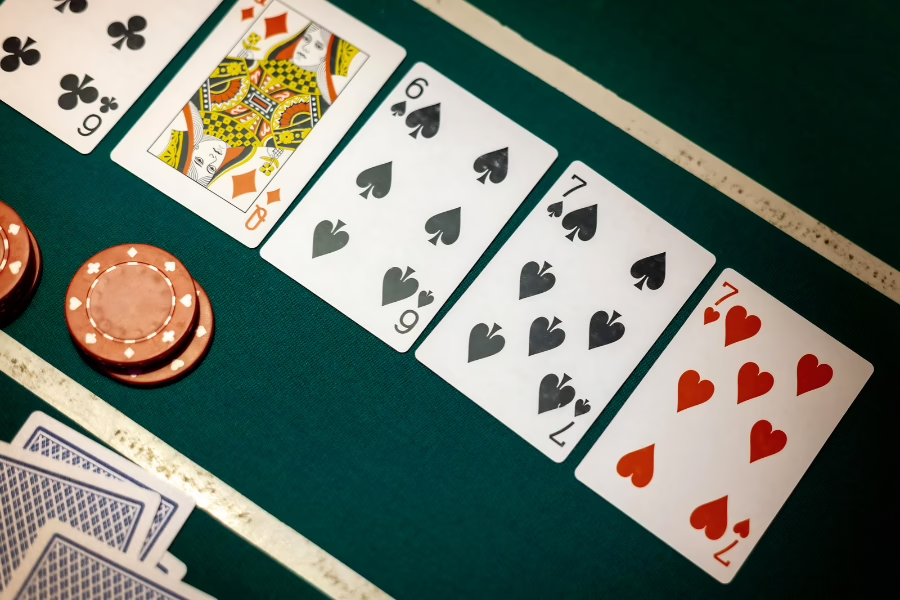
There are no shared community cards. Each player is dealt their own mix of face-up and face-down cards over several betting rounds. Seven-Card Stud and Razz belong here.
Draw games
Players receive a complete private hand and can improve it by discarding some cards and drawing replacements. Five-Card Draw is the classic example.
These structural differences affect strategy. Community-card games emphasize board reading and position. Stud games reward memory and the ability to track exposed cards. Draw games place more weight on hand selection and discipline.
Texas Hold’em
Hold’em is by far the most popular form of poker in the world. It is the game you see in most televised tournaments, including the World Series of Poker Main Event, and it accounts for the large majority of cash games and tournaments both online and in live card rooms.
In Texas Hold’em, each player is dealt two private hole cards. Five community cards are then dealt face-up in three stages:
- The flop: Three cards.
- The turn: One card.
- The river: One card.
Players make the best five-card hand using any combination of their hole cards and the community cards. A player can use both hole cards, one, or none.
The game is most commonly played as No-Limit Hold’em, meaning players can bet any amount up to their entire stack at any time. Fixed-limit and pot-limit versions also exist, but No-Limit is the dominant format.
Because only two cards are private, hand reading is relatively straightforward compared with other variants, which is one reason Hold’em is considered beginner-friendly while still offering deep strategic complexity.
Omaha
Omaha is the clear second-most popular poker variant. It uses the same community-card structure as Hold’em (flop, turn, and river) but deals each player four hole cards instead of two.
The critical rule is that a player must use exactly two of their hole cards combined with exactly three community cards to make their best five-card hand.
This “exactly two and three” requirement changes strategy significantly. Hands that look strong in Hold’em can be much weaker in Omaha, and drawing hands become far more powerful.
Because the equity between hands is often closer, pots tend to get larger and the game has higher variance.

Popular Omaha Variants
Pot-Limit Omaha (PLO)
The most common form is Pot-Limit Omaha (PLO), in which the maximum bet is the size of the current pot.
Omaha Hi-Lo
Omaha Hi-Lo (also called Omaha Eight-or-Better) is another popular version in which the pot is split between the best high hand and the best qualifying low hand.
In Hi-Lo, a low hand must use five unpaired cards ranked eight or lower.
Seven-Card Stud
Before Texas Hold’em rose to dominance in the early 2000s, Seven-Card Stud was the most popular form of poker. It remains an important game, especially in mixed formats, and is still spread in many live card rooms.
In Seven-Card Stud, each player is dealt seven cards over several betting rounds: three face-down and four face-up. There are no community cards. The player with the best five-card hand from their seven cards wins the pot.
Because some of every player’s cards are visible, memory and observation are more important than in Hold’em or Omaha.
Seven-Card Stud is almost always played with a fixed-limit betting structure. The player with the lowest exposed card starts the action on the early streets, and the highest exposed hand acts first after that.
Stud Hi-Lo (Stud Eight-or-Better) is a split-pot version that follows the same dealing pattern.
Five-Card Draw
Five-Card Draw is one of the oldest and simplest forms of poker. For many people, it was the first poker game they learned.
Each player is dealt five private cards. After a betting round, players may discard any number of cards and receive replacements.
A final betting round follows, and the best five-card hand wins.
Because all cards remain hidden until showdown, Five-Card Draw is more about hand selection and less about reading a board.
It is rarely spread in modern casinos or online poker rooms as a cash game, but it remains popular in home games and is sometimes included in mixed-game rotations.
Other Notable Poker Variants
Razz
Razz is a lowball stud game. The dealing structure is identical to Seven-Card Stud, but the lowest hand wins.
The best possible hand is A-2-3-4-5 (ace plays low). Razz is almost always played fixed-limit and appears frequently in mixed games.
Short Deck (Six-Plus Hold’em)
Short Deck is a relatively modern community-card variant played with a 36-card deck in which all cards ranked 2 through 5 are removed.
The game follows Hold’em dealing rules but changes hand rankings slightly (a flush usually beats a full house). It has gained popularity in high-stakes games, particularly in Asia.
Chinese Poker and Open-Face Chinese
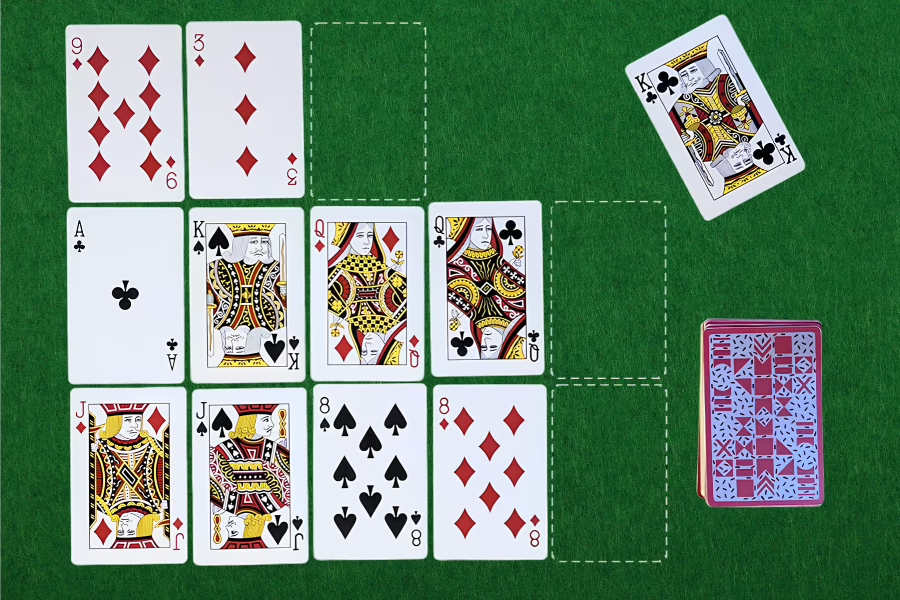
Chinese Poker is a non-betting comparison game in which each player is dealt 13 cards and must arrange them into three rows:
- A three-card front.
- A five-card middle.
- A five-card back.
Open-Face Chinese (OFC) is a more popular modern version in which cards are dealt face-up over several rounds and players set their hands as the cards arrive.
These games emphasize hand construction and are often played for points rather than traditional poker betting.
Mixed Games (HORSE, 8-Game, and Others)
Mixed games rotate between several poker variants during a single session.
The best-known is H.O.R.S.E., which consists of:
- H: Hold’em
- O: Omaha Hi-Lo
- R: Razz
- S: Seven-Card Stud
- E: Stud Hi-Lo
The 8-Game mix adds No-Limit Hold’em, Pot-Limit Omaha, and 2-7 Triple Draw.
Mixed formats reward players who are competent across multiple games and are common in high-stakes live events.
Which Poker Game Should You Learn First?
For almost every new player, Texas Hold’em is the best starting point. It is the most widely available game, has the largest amount of learning material, and is relatively easy to understand.
Once you are comfortable with Hold’em, Pot-Limit Omaha is a natural next step if you enjoy more action and bigger draws. Stud and draw games are worth learning if you play mixed formats or want to develop a broader skill set.
Regardless of the variant, the core principles remain the same:
- Understand hand rankings.
- Manage your bankroll.
- Pay attention to position.
- Make decisions based on expected value.
Learning multiple games can give you an edge, because many players are strong in only one format.
Conclusion
While Texas Hold’em dominates the modern poker landscape, the broader family of poker games offers variety in structure, skill requirements, and style of play.
Community-card games like Hold’em and Omaha emphasize shared boards and position. Stud games reward observation and memory. Draw games focus on pure hand strength and selective play. Mixed formats test versatility across all of these.
Understanding the main types of poker games makes it easier to choose where to play, learn the rules correctly, and appreciate the different strategic challenges each format presents.
Start with Hold’em, explore Omaha when you want more action, and consider stud, draw, or mixed games as your experience grows.


