What Is a Cooler in Poker?
A cooler is one of the most frustrating experiences in poker. You hold a monster hand, you get all your chips in the middle with complete confidence, and then you discover that your opponent has an even stronger hand.
There was no bad decision. There was no obvious mistake. The cards simply lined up so that the second-best hand lost a huge pot.
Understanding coolers helps you separate unavoidable variance from actual leaks in your game. It also protects your mindset. When you can recognize a true cooler, you are less likely to tilt or change your strategy after a painful loss.
What Exactly Is a Cooler?
In poker, a cooler is a situation in which two (or more) players both hold very strong hands, the chips go into the pot because neither player can reasonably fold, and the player with the second-best hand loses.
The key element is that folding would have been a mistake given the information available at the time.
A good test is simple: if almost any competent player would have lost the same amount of chips with your exact cards, it was a cooler. You were not outplayed. You were simply second best at the worst possible moment.
Classic Cooler Examples
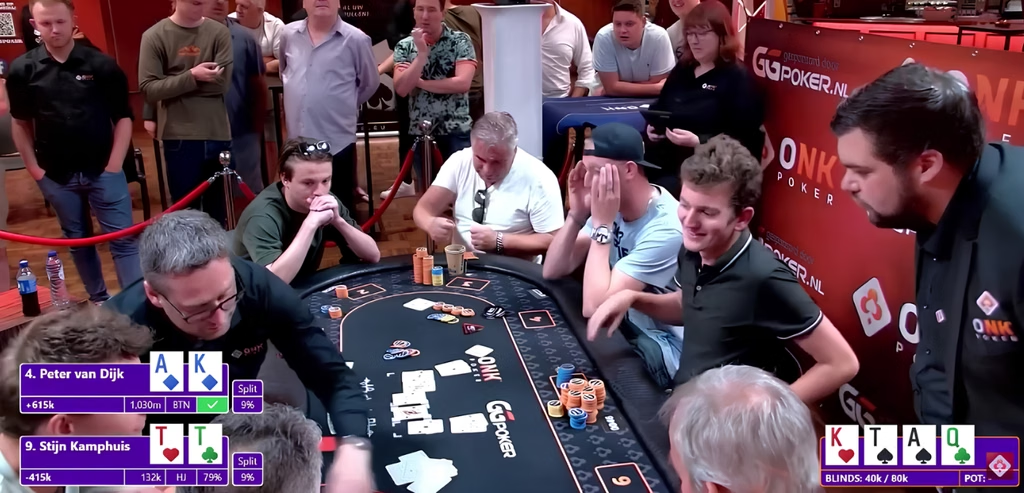
Pocket Aces versus Pocket Kings Preflop
This is the textbook cooler.
Pocket kings are the second-best starting hand in Texas Hold’em. Almost no player folds them preflop for a normal stack. When they run into pocket aces, the kings are roughly an 82/18 underdog.
Both players are correct to get the money in. One of them simply loses.
Set over Set
You hold pocket nines and the flop comes 9-Q-2. You have flopped a set.
Your opponent holds pocket queens and has also flopped a set. Both of you believe you have a monster, so the money goes in on the flop or turn.
Set-over-set is one of the most common ways full stacks get transferred in no-limit Hold’em.
Flush over Flush
You make a king-high flush. Your opponent makes the ace-high flush on the same board.
Both hands are extremely strong, and neither player is folding to normal bet sizes. The higher flush wins.
Full House versus Bigger Full House or Quads
The board pairs and you fill up. You feel confident until your opponent shows a higher full house or four of a kind.
These spots are especially painful because the strength of your hand looks nearly unbeatable until the cards are revealed.
Straight versus Higher Straight
You hold the bottom end of a straight. Your opponent holds the top end.
On many boards both players can reasonably get the money in, especially if the board is not heavily coordinated with flush draws.
Other Coolers
Cooler versus Bad Beat: The Important Difference
Players often confuse coolers with bad beats, but they are different concepts.
A bad beat occurs when you are a clear favorite when the money goes in and your opponent gets lucky on a later card.
Classic example: you hold pocket aces, your opponent holds a weak draw, and they hit their outs on the river. You were ahead. They got lucky.
A cooler occurs when you were behind (or roughly equal) the entire time. Nobody got “lucky” on the river. Your strong hand simply lost to a stronger hand that was already there.
A useful mental check: if you had seen your opponent’s cards when the chips went in, would you have felt sick? If the answer is yes, it was probably a cooler. If you would have been happy to get the money in, it was a bad beat.
Why Is It Called a Cooler?
The term most likely comes from the older poker expression “cold deck.”
A cold deck is a deck that has been intentionally stacked by a cheater so that one player is dealt a strong hand while another is dealt an even stronger one. When a legitimate cooler happens, it can feel exactly like someone stacked the deck against you. Over time, players shortened the idea into the single word “cooler.”
Another explanation is more literal: the hand “cools” you down. You were hot, confident, and ready to stack someone. Then the reality of the cards freezes your momentum.
How Often Do Coolers Happen?
True coolers are less common than many players believe, but they are still a regular part of the game.
| Pocket aces versus pocket kings all-in preflop | This occurs roughly once every 20,000+ hands in a typical cash game or tournament. |
| Set over set | This is more frequent. When two players both hold pocket pairs and see a flop, the chance both flop sets is roughly 1 in 142. |
In a normal session you may not see one. Over thousands of hands you will experience several. This is simply variance. In the long run you will also be on the winning side of the same number of coolers.
Can You Avoid Coolers?
Mostly, no. That is the point of the term.
If you start folding pocket kings or flopped sets simply because they might be second best, you will lose far more money on all the hands where you were actually ahead.
What you can do is make sure the hand really was a cooler and not a leak:
- On highly coordinated boards, medium-strength hands are often not coolers. They are hands you should have slowed down with.
- When a tight, passive player suddenly starts raising aggressively on the river, their range is usually very strong. Continuing with second-best hands in these spots is often a mistake rather than a cooler.
- Stack sizes matter. Getting all-in preflop with kings against a very tight player who only 4-bets or 5-bets with aces is closer to a cooler than getting it in against a loose aggressive player.
The goal is not to avoid every cooler. The goal is to avoid calling them coolers when they were actually avoidable.
How to Handle a Cooler Mentally
Coolers hurt. The emotional response is normal. The professional response is to recognize what happened and move on.
- Label it correctly. Say to yourself, “That was a cooler,” instead of “I played it badly” or “The poker gods hate me.”
- Take a short break if you need one. Walk around, get water, or sit out a few hands. Do not try to win the money back immediately.
- Remember the long-term math. You will be the one holding the aces or the higher set just as often.
- Review the hand later with a clear head. Confirm that folding was not realistic. If it was not, file the hand away as variance and keep playing your normal strategy.
Bankroll management also helps. When you have enough buy-ins behind you, one cooler is an inconvenience rather than a disaster.
Coolers in Tournaments versus Cash Games
Coolers exist in both formats, but the consequences differ.
In cash games you can rebuy. A cooler costs you one buy-in (or a large portion of your stack). You reload and continue.

ICM considerations sometimes make the decision slightly different in extreme spots, but the core idea remains the same: strong hands still get the money in most of the time.
Final Thoughts
A cooler is not a sign that you are unlucky or that you played poorly. It is evidence that you got your money in with a hand that almost any good player would also get in. The second-best hand lost to the best hand, and there was nothing reasonable you could have done about it.
The next time you lose a big pot and feel the sting, ask yourself one question: would a solid player have folded in my shoes?
If the answer is no, you experienced a cooler. Take a breath, note it, and get back to making the next correct decision. The cards will even out over time. Your job is to still be making good decisions when they do.