What Is a Boat in Poker?

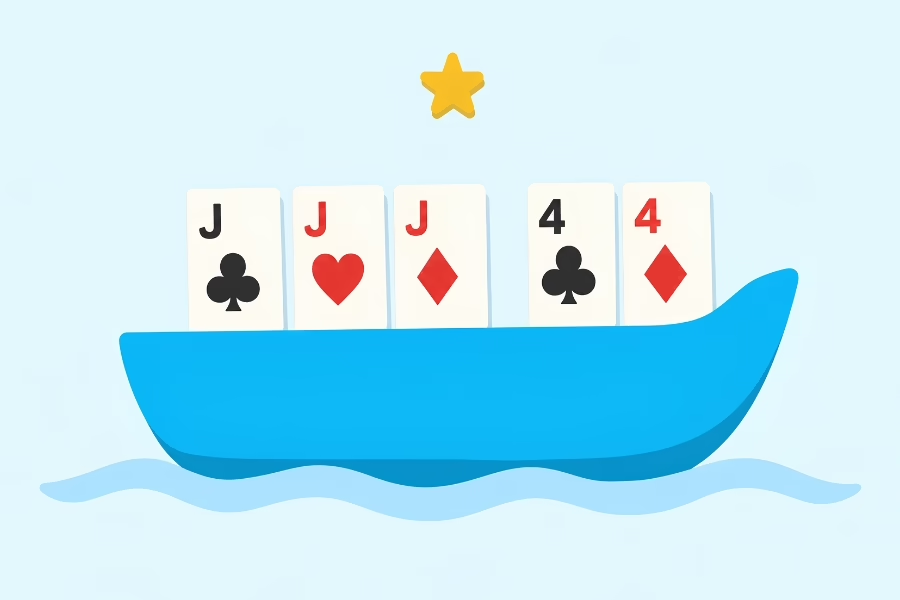
In poker, a “boat” is simply another name for a full house. It is the hand made up of three cards of one rank and two cards of another rank. Players have used the term for decades, and at most live tables you will hear “boat” more often than the formal “full house.”
The hand ranks fourth on the standard poker hierarchy. It beats a flush and a straight, and it loses only to four of a kind, a straight flush, or a royal flush. Because it is strong yet still appears with some frequency, knowing how to form it, name it, and play it is essential.
The Short Answer
A boat is poker slang for a full house: three cards of one rank plus two cards of another rank (for example, three jacks and two sevens, announced as “jacks full of sevens”).
It beats a flush, a straight, and every weaker hand. It loses to four of a kind, a straight flush, and a royal flush. When two boats face each other, the higher three of a kind wins; if those are equal, the higher pair decides.
Where the Term “Boat” Comes From
No single origin story is universally accepted, but the most common explanation ties the word to 19th-century riverboat gambling on the Mississippi.
At a time when many land-based gambling laws were strict, poker flourished on steamboats. Players on these “boats” began calling a full house a “full boat.” Over time the “full” dropped away in everyday speech, and the shorter “boat” stuck.
Other theories exist. One suggests a phonetic shortening of “full house.” Another notes that when cards are arranged with the pair on top and the three of a kind below, the shape can vaguely resemble a boat.
How to Announce a Boat
Boats are named by the three of a kind first, then the pair. The standard phrasing is “X’s full of Y’s,” where X is the rank of the trips and Y is the rank of the pair.
Examples:
- Aces and kings: “aces full of kings” or simply “aces full.”
- Kings and queens: “kings full of queens.”
- Sevens and fives: “sevens full of fives.”
You never reverse the order. “Fours full of jacks” is incorrect if you hold three jacks and two fours; that hand is “jacks full of fours.” At the table players often drop the “of” and just say the trips rank plus “full.”
When two players both hold boats, the one with the higher three of a kind wins.
Aces full of twos beats kings full of queens. If the three-of-a-kind ranks are identical (possible when the board supplies the trips), the higher pair decides. Suits never matter.
How You Make a Boat in Texas Hold’em
In Texas Hold’em each player receives two hole cards and five community cards are dealt. The best five-card combination from the seven available cards is used.
A boat can be completed in several common ways:
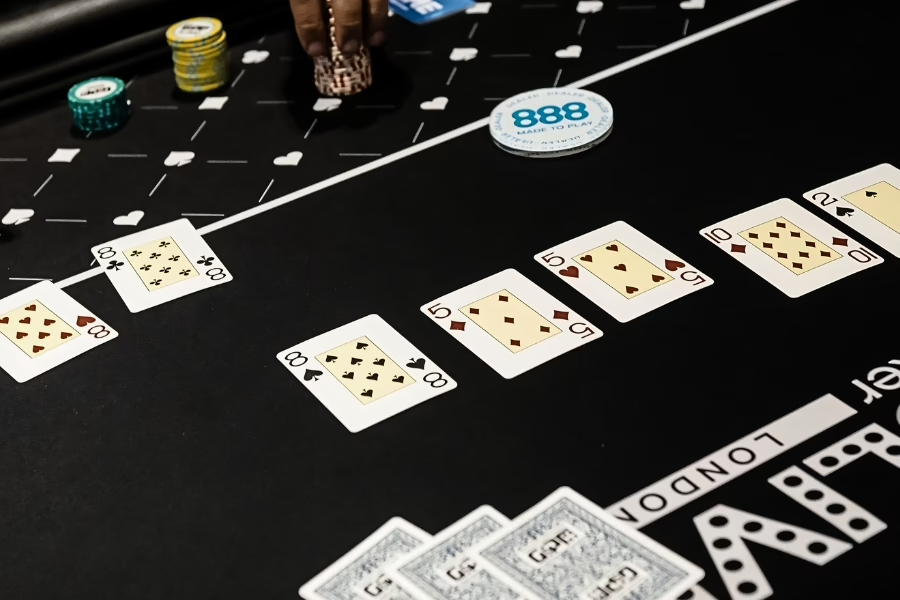
Pocket Pair + Board Pair + Matching Card
You hold 8♠ 8♥. The board comes 8♦ 2♣ 2♥. You have eights full of twos.
Two Pair That Fills Into a Boat
You hold A♦ K♣. The board is A♠ K♥ 7♣ and the turn or river brings another ace or king. You now have a boat.
Board Provides Most of the Hand
The board shows Q-Q-Q-4-4. Everyone can play the board boat (queens full of fours) unless a player holds a higher boat using one or both hole cards.
Pocket pairs are the most efficient starting hands for making a boat by the river. With a pocket pair the chance of finishing with a full house is roughly 1 in 12; with unpaired hole cards it is closer to 1 in 45.
Odds of Making a Boat
In a raw five-card deal a full house occurs about once every 694 hands (approximately 0.144 percent). In Texas Hold’em, where you select the best five cards from seven, the frequency rises.
By the river roughly 2.6 percent of hands finish as a full house—about 1 in 38.5.
Specific starting-hand odds on the flop:
- Any two cards: ~0.14 percent (1 in ~714)
- Unpaired hand: ~0.09 percent
- Pocket pair: ~0.98 percent (about 1 in 102)
These numbers explain why a boat feels special when it arrives yet is still common enough that experienced players see several per session.
Strategy Tips for Playing a Boat
A boat is usually a hand you want to get value from. Most of the time you should bet and raise for value rather than slow-play, especially on boards where opponents can have strong second-best hands such as top pair, two pair, or a flush.
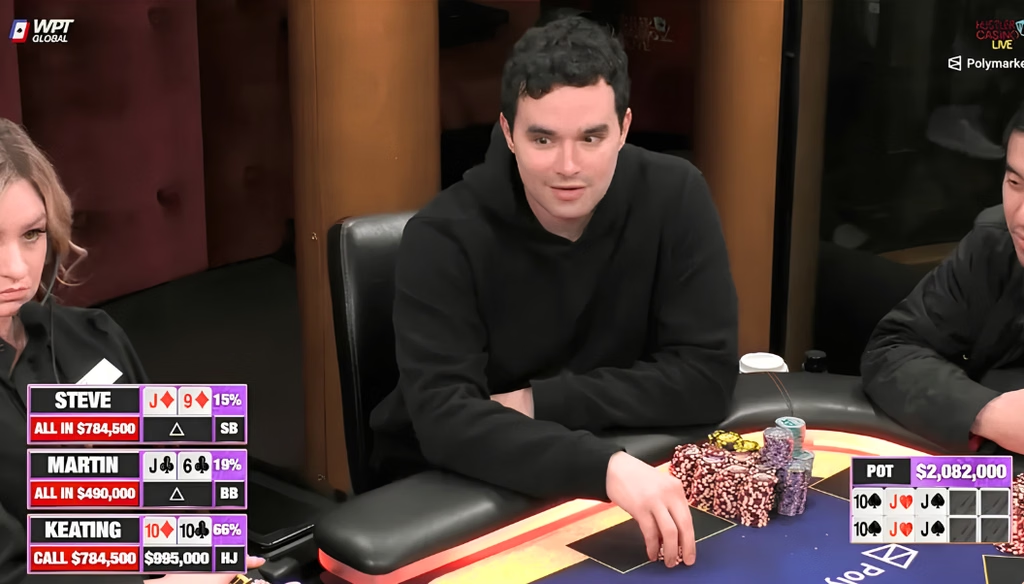
Be alert on paired boards. When the board pairs, the possibility of a bigger boat increases. A player with a medium boat (for example, tens full of sixes on a board of T-T-6-x-x) can still lose to a higher boat. Size your bets accordingly and consider the range of hands that can beat you.
Slow-playing can occasionally be correct on dry, uncoordinated boards where opponents are unlikely to have much. In most cases, however, the strength of the hand is better used to build a large pot while you still hold the lead.
Always remember the comparison rule: the three of a kind ranks first. Announcing your boat correctly and evaluating opposing boats quickly prevents costly showdown mistakes.